Most home bars start the same way: a nice whiskey, a gifted shaker, and a shelf of bottles used once a year. The problem isn't commitment — it's buying things in the wrong order. Build around what you'll actually make, not what looks impressive. Here's how to do it in stages.
Stage 1: The Foundation (Make 10 Cocktails Well)
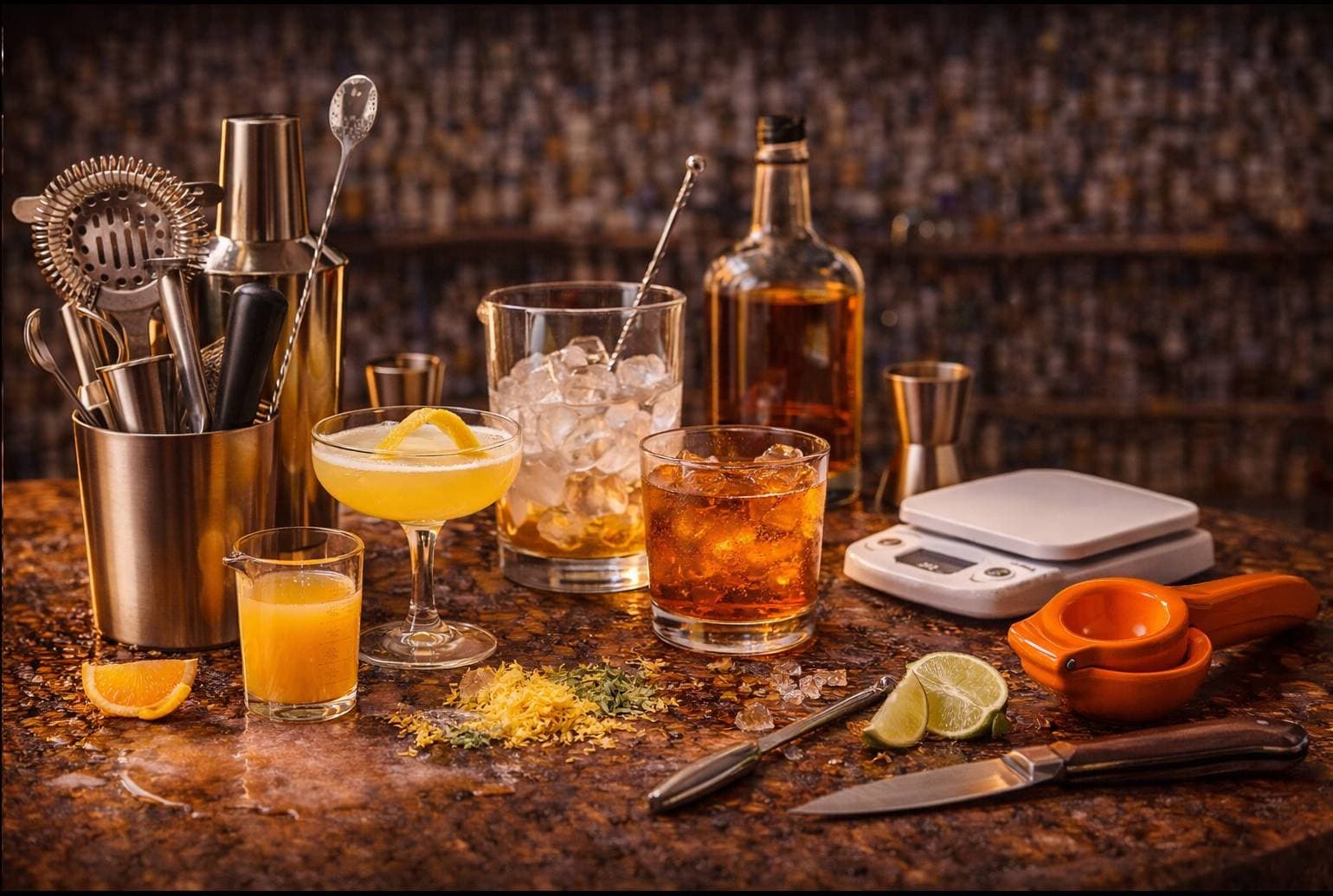
Before you buy a single obscure liqueur, you need the tools and spirits that cover the broadest range of drinks. This stage costs less than a nice dinner out and lets you make roughly 10 classic cocktails credibly.
Tools:
- A jigger — the single most important bar tool. A Japanese-style jigger (2 oz / 1 oz) with interior markings covers every measurement. See our article on why a jigger matters.
- A shaker — a Boston shaker (tin-on-tin) is the best value. Pair it with a Hawthorne strainer. See our shaker guide and strainer guide.
- A bar spoon — for stirred drinks. Either Japanese or American style works. See our bar spoon guide.
- A cutting board and sharp knife — for citrus. You probably already have these.
- A citrus juicer — a simple handheld press is fine. Fresh juice makes a bigger difference than any spirit upgrade.
Spirits (the core 4):
- Bourbon or rye whiskey — for Old Fashioneds, Whiskey Sours, Manhattans
- Gin — for Martinis, Gin & Tonics, Gimlets, Negronis
- White rum — for Daiquiris, Mojitos, Cuba Libres
- Tequila blanco — for Margaritas, Palomas, Tequila Sunrises
Mixers and ingredients:
- Fresh limes and lemons (buy weekly, squeeze fresh)
- Simple syrup (make your own — see our syrup guide)
- Angostura bitters (one bottle lasts years)
- Soda water, tonic water
Glassware:
- 4 rocks glasses and 4 highball glasses — these two cover most drinks. See our glassware guide.
What you can make with Stage 1: Old Fashioned, Whiskey Sour, Margarita, Daiquiri, Gin & Tonic, Mojito, Gimlet, Paloma, Cuba Libre, Tequila Sunrise. That's 10 drinks that cover shaken, stirred, built, sour, spirit-forward, and highball styles.
Stage 2: Expand Your Range (Make 25+ Cocktails)
Once you're comfortable with the basics and making drinks regularly, add the bottles and tools that unlock the next tier.
Tools:
- A mixing glass — for properly stirred cocktails. Upgrades your Manhattans and Negronis immediately. See our mixing glass guide.
- A julep strainer — pairs with the mixing glass. See our strainer guide.
- A fine mesh strainer — for double-straining drinks served up.
- A muddler — for Mojitos, Old Fashioneds, Caipirinhas. See our article on muddlers and underrated tools.
- A channel knife or Y-peeler — for citrus garnishes. See our citrus guide.
Spirits:
- Vodka — for Cosmopolitans, Moscow Mules, Espresso Martinis
- Dark or aged rum — for Dark & Stormys, Mai Tais, rum Old Fashioneds
- Scotch or Irish whiskey — for Penicillins, Rob Roys, Irish Coffee
Liqueurs and modifiers:
- Sweet vermouth — unlocks Manhattans, Negronis, Boulevardiers
- Dry vermouth — unlocks Martinis
- Cointreau or triple sec — unlocks Margaritas (proper), Sidecars, Cosmopolitans
- Campari — unlocks Negronis, Boulevardiers, Americanos
- Orange bitters — a second bitters alongside Angostura
Glassware:
- 4 coupes — for drinks served up
What Stage 2 adds: Manhattan, Negroni, Martini, Cosmopolitan, Moscow Mule, Sidecar, Boulevardier, Caipirinha, Dark & Stormy, Espresso Martini, Penicillin, Americano, Rob Roy, Corpse Reviver #2. You're now covering most of what a solid cocktail bar serves.
Stage 3: Find Your Style (Specialize)
By this point, you know what you like making. Stage 3 is about going deeper into your preferred style rather than trying to stock everything.
If you love Tiki and tropical:
- Aged Jamaican rum, overproof rum, orgeat, falernum, allspice dram
- A Lewis bag for crushed ice — see our underrated tools guide
- Tiki mugs if you want the full experience
If you love stirred and spirit-forward:
- Higher-quality base spirits (bonded bourbon, single malt Scotch, London dry gin)
- Maraschino liqueur, Chartreuse, Bénédictine
- A nice set of Nick & Nora glasses
- Clear ice molds — see our ice quality guide
If you love batch cocktails and frozen drinks:
- A frozen drink machine (Ninja SLUSHi for consumer, Spaceman for commercial)
- A Brix refractometer — see our Brix guide and refractometer comparison
- Bulk spirits and mixers
- Browse our batch recipes for tested 1-gallon formulations
If you love low-ABV and aperitivo drinks:
- Aperol, Lillet Blanc, Cocchi Americano, amaro
- Sparkling wine (for Spritzes)
- Wine glasses
Stage 4: The Details
These are the small additions that round out a mature home bar. None are essential, but each makes specific tasks easier or more enjoyable.
- Demerara syrup (2:1) for richer Old Fashioneds and Tiki drinks
- Honey syrup (1:1) for Bee's Knees and Gold Rush
- Peychaud's bitters for Sazeracs
- Chocolate bitters for Espresso Martini variations
- Luxardo cherries for Manhattans and Old Fashioneds (not the neon-red ones)
- Ice molds — large cubes and spheres for rocks drinks
- A speed pourer set — for bottles you use frequently
- A bar mat — keeps your workspace clean and catches drips
The Rules of a Bar That Gets Used
Keep it accessible. If your bar is in a cabinet that requires moving things to access, you won't use it. A dedicated shelf, cart, or counter section that's always visible and ready means the barrier to making a drink is low.
Stock fresh citrus weekly. Limes and lemons are the most perishable bar ingredient and the most important one. Buy 4–6 of each per week and squeeze them fresh. This single habit elevates every drink you make more than any bottle upgrade. See our citrus guide for more.
Make syrup in advance. A bottle of simple syrup in the fridge means you're always 2 minutes away from a cocktail. Without it, you're 10 minutes away, and that's often enough to make you pour whiskey neat instead. See our syrup guide for shelf life and variations.
Rotate what you make. If you make the same Old Fashioned every night, the bottles you don't use become decoration. Try a new recipe once a week. Our Ingredient Matcher shows you what you can make with what you already have — it's designed exactly for this.
Don't buy bottles for one recipe. Chartreuse is incredible, but if the only drink you'd make with it is a Last Word, that $60 bottle sits untouched after you make it twice. Wait until a bottle serves at least 3–4 drinks in your regular rotation before investing.
Accept that some bottles will sit. Every bar has a few bottles that seemed like a good idea and turned out not to be. That's fine. They don't expire quickly (most spirits last indefinitely once opened). Give them time — you might discover a recipe that makes them essential.
The Starter Shopping List
If you're building from zero and want to spend wisely, here's the single shopping trip that gets you started:
Tools (~$40–60): Japanese jigger, Boston shaker (tin-on-tin), Hawthorne strainer, bar spoon, handheld citrus press
Spirits (~$60–100): Bourbon, gin, white rum, tequila blanco (mid-shelf, not bottom-shelf — the difference matters in cocktails where the spirit is the star)
Ingredients (~$15–20): Angostura bitters, 6 limes, 6 lemons, white sugar (for syrup), soda water, tonic water
Glassware (~$20–30): 4 rocks glasses, 4 highball glasses
Total: roughly $135–210 for a home bar that makes 10+ cocktails properly. Everything else is incremental from here.
Check our Bar Tools page for specific product recommendations on every tool mentioned above.
Ready to start? Browse our cocktail recipes to find drinks you can make with your setup, or use our Ingredient Matcher to discover what's possible with what you already have.