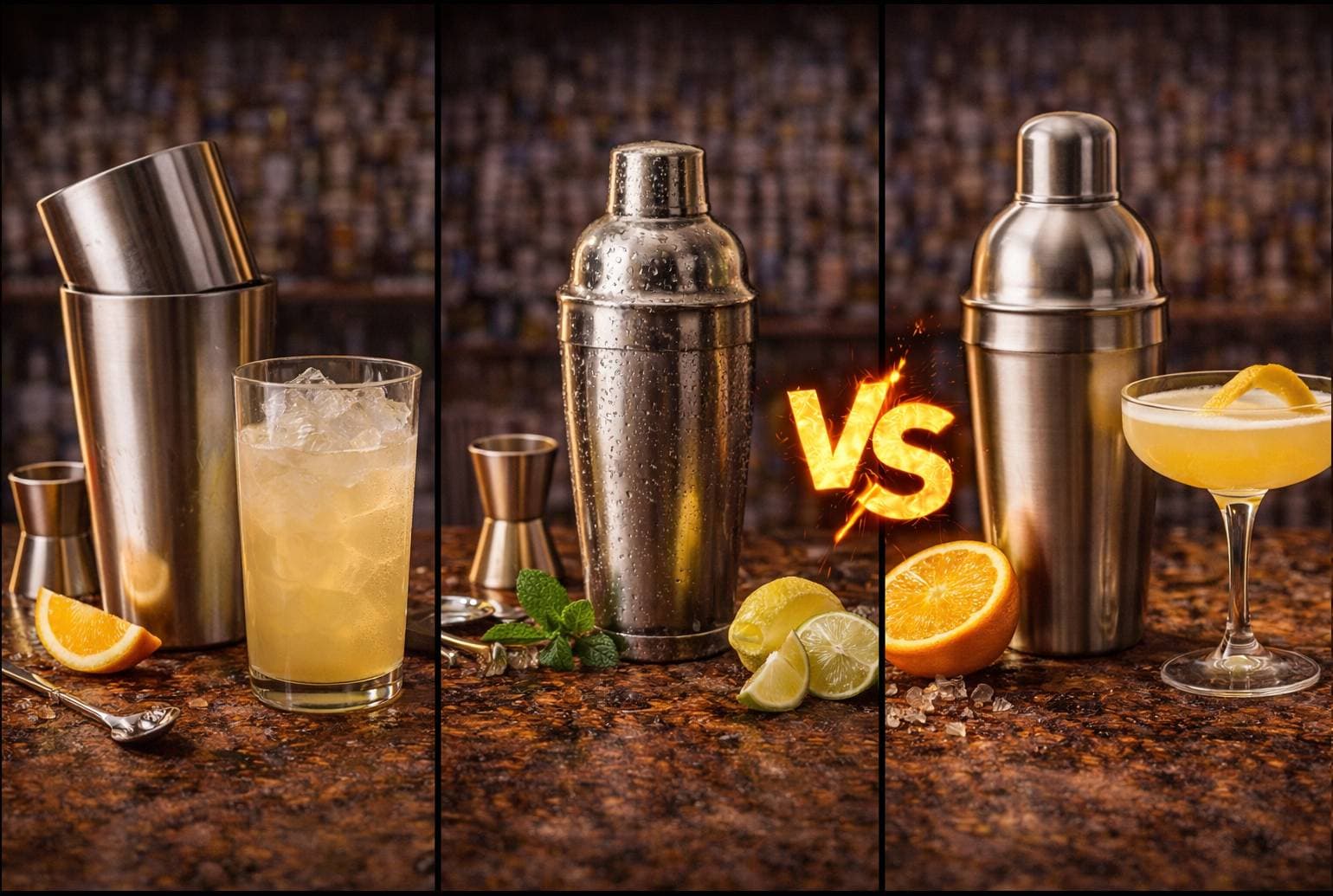
Hay tres tipos de cocteleras, y la mayoría de las personas compran la equivocada primero. La cobbler — el diseño de tres piezas con colador integrado — es la elección más común para principiantes, pero la que los profesionales casi universalmente evitan. Aquí explicamos qué hace cada tipo y cuál pertenece en tu bar.
La Coctelera Boston
La coctelera Boston son dos piezas: un vaso metálico grande (28 oz) y un vaso más pequeño de metal o cristal (16–18 oz). Combinas los ingredientes en una mitad, sellas las dos mitades juntas con un golpe firme, agitas, luego rompes el sello con un golpe seco en el lateral cerca del borde.
Por qué la usan los profesionales:
Velocidad. La coctelera Boston se abre y cierra más rápido que cualquier otro diseño. No hay roscas, no hay giros, no hay tapa que desenroscar. La golpeas para cerrar, agitas, la golpeas para abrir. Durante cientos de bebidas en un turno, esos segundos ahorrados se acumulan significativamente.
Capacidad. El interior combinado contiene sustancialmente más volumen que una coctelera cobbler — suficiente para dos cócteles completos más hielo. Si estás haciendo una ronda de Margaritas para cuatro personas, puedes hacerlo en dos agitadas en lugar de cuatro.
Limpieza. Dos recipientes lisos y abiertos se enjuagan limpiamente en segundos. Sin tapas estrechas, sin pequeños agujeros de colador que fregar, sin roscas donde se esconde el jarabe pegajoso.
Durabilidad. Las cocteleras Boston completamente metálicas (metal sobre metal) son esencialmente indestructibles. Se abollan pero no se rompen. Las versiones de metal sobre cristal son más frágiles — el cristal puede agrietarse por choque térmico si está muy frío y lo enjuagas con agua caliente — pero te permiten ver la bebida mientras la preparas, lo que algunas personas prefieren.
La curva de aprendizaje:
La coctelera Boston tiene un sello que depende de la física, no de roscas. Golpeas la pieza más pequeña dentro de la más grande en un ángulo ligero, creando un sello de presión cuando el líquido frío contrae el metal. Romper ese sello requiere un golpe firme en el lugar correcto — usualmente el talón de tu palma golpeando donde las dos piezas se superponen. Los principiantes ocasionalmente luchan con esto. Después de unas pocas sesiones, se vuelve automático.
También necesitas un colador separado — la coctelera Boston no tiene colador integrado. Un colador Hawthorne es el emparejamiento estándar.
La Coctelera Cobbler
La coctelera cobbler son tres piezas: un vaso base, una tapa ajustada con colador integrado, y una tapa pequeña que cubre la abertura del colador. Ensamblas las tres, agitas, quitas la tapa, y viertes a través del colador integrado.
Por qué la compran los principiantes:
Es intuitiva. El diseño todo-en-uno tiene sentido inmediatamente — llénala, tápala, agítala, viértela. No se necesita colador separado. Se ve como lo que una "coctelera" se supone que debe parecer en la imagen mental de la mayoría de las personas.
Por qué es frustrante en la práctica:
La tapa se atasca. El metal se contrae cuando está frío. Después de agitar con hielo, la tapa a menudo se sella tan fuertemente que luchas con ella mientras tus invitados observan. Esta es la queja más común sobre las cocteleras cobbler, y sucede consistentemente — no ocasionalmente.
El colador integrado es demasiado fino para algunas bebidas y demasiado grueso para otras. Atrapa hielo pero deja pasar una cantidad sorprendente de pulpa y pequeños trozos de hielo. Y porque los agujeros del colador están perforados en la tapa, son difíciles de limpiar — la pulpa de cítrico seca se aloja en ellos y requiere un palillo o cepillo para remover.
La capacidad es pequeña. La mayoría de las cocteleras cobbler contienen 16–24 oz en total — apenas suficiente para un cóctel más hielo. Hacer dos bebidas significa agitar dos veces.
El vertido es lento. Las pequeñas aberturas del colador restringen el flujo. Una bebida que se vierte en 3 segundos desde una coctelera Boston toma 8–10 segundos desde una cobbler. Para una bebida en casa, esto es irrelevante. Para cualquier tipo de volumen, es doloroso.
Cuándo tiene sentido una cobbler:
Si agitas cócteles raramente y no quieres comprar un colador separado, una cobbler es una solución funcional todo-en-uno. También funciona bien para bebidas donde el vertido lento es realmente deseable — un Ramos Gin Fizz, por ejemplo, donde quieres que la espuma se forme mientras la bebida fluye lentamente a través del colador.
La Coctelera Francesa (Parisina)
La coctelera francesa son dos piezas — como una coctelera Boston — pero ambas mitades son de metal y encajan juntas con una superposición lisa y ajustada en lugar del sello angulado de la Boston. Se ve como una versión aerodinámica de la cobbler sin la tapa colador. Estéticamente, es la más elegante de las tres.
El atractivo:
Combina la velocidad y simplicidad de la coctelera Boston con un aspecto más refinado. El diseño de dos piezas se abre y cierra fácilmente, la construcción completamente metálica es duradera, y las líneas suaves son atractivas en un bar.
Las limitaciones:
Sin colador integrado — como la Boston, necesitas un colador Hawthorne separado. El sello de superposición lisa significa que puede ser ligeramente más difícil de abrir que una Boston (no hay "punto de golpe" claro para el talón de tu mano). Y porque ambas mitades tienen la misma forma, pierdes la ventaja visual de la mitad de cristal de la Boston — no puedes ver la bebida mientras la preparas.
Las cocteleras francesas son menos comunes que los diseños Boston o cobbler, lo que significa menos opciones de tamaño y a veces precios más altos por calidad comparable.
Cuándo tiene sentido:
Si te gusta el enfoque de dos piezas Boston pero prefieres la estética más limpia y el sello más suave. Es una preferencia de estilo más que funcional.
La Física del Agitado
Sin importar qué coctelera uses, la física es la misma. Entenderlas te ayuda a agitar mejor.
Temperatura: Un agitado apropiado (10–15 segundos, vigoroso) baja la temperatura de la bebida a aproximadamente 23–25°F. El hielo golpea contra las paredes y se rompe en piezas más pequeñas, aumentando dramáticamente el área superficial y la transferencia de calor. Sentirás la coctelera enfriarse en tus manos — cuando el exterior del vaso está escarchado, has terminado.
Dilución: Agitar añade aproximadamente 25–30% de agua al volumen total de la bebida a través del derretimiento del hielo. Esta dilución es intencional — es parte de la receta. Para más sobre cómo funciona la dilución, ve nuestro artículo sobre La Ciencia de la Dilución.
Aireación: El movimiento violento incorpora pequeñas burbujas de aire, creando una textura espumosa y ligeramente opaca. Esto es especialmente importante para bebidas con clara de huevo, jugo de cítrico, o crema — las proteínas y ácidos atrapan aire y crean espuma. Un agitado suave produce menos espuma. Un agitado fuerte produce más. La intensidad de tu agitado es una variable que controlas.
Sello: Tanto las cocteleras Boston como las francesas dependen de la contracción térmica para mantener su sello. Cuando el hielo enfría el metal, se contrae ligeramente, ajustando la superposición. Por esto es que el sello se vuelve más fuerte mientras agitas y por qué necesitas romperlo con un impacto agudo después.
¿Cuál Deberías Comprar?
Para la mayoría de bartenders caseros: Coctelera Boston (metal sobre metal).
La curva de aprendizaje es real pero corta — tal vez tres o cuatro sesiones antes de que el sellar-y-romper se vuelva natural. Después de eso, tienes la coctelera más rápida, versátil y fácil de limpiar disponible. Combínala con un colador Hawthorne y estás listo.
Si quieres la mitad de cristal: La coctelera Boston (metal sobre cristal) te permite ver la bebida mientras la preparas y se ve genial. Solo maneja el cristal con cuidado razonable — no viertas agua hirviendo en un vaso escarchado.
Si raramente agitas y quieres simplicidad: Una coctelera cobbler funciona. Solo ten en cuenta que el problema de la tapa congelada es real y eventualmente querrás mejorar.
Si la estética importa más que cualquier cosa: Coctelera francesa. Es la opción más hermosa y funciona casi idénticamente a una Boston.
Qué evitar: Cocteleras extremadamente baratas con paredes delgadas (se abollan mal y no mantienen bien un sello frío), cocteleras novedosas con forma de pingüinos o cohetes, y cualquier coctelera comercializada como "a prueba de fugas" — se supone que el sello debe ser lo suficientemente ajustado que las fugas no sean una preocupación con cualquier coctelera bien hecha.
Revisa nuestra página de Herramientas de Bar para recomendaciones específicas de cocteleras.
La Conclusión
La coctelera Boston es el estándar de la industria por una razón. Es rápida, grande, duradera y fácil de limpiar. La cobbler es conveniente para uso casual pero frustrante para cualquiera que haga cócteles regularmente. La coctelera francesa es un término medio elegante. Las tres producen la misma bebida — la diferencia está en qué tan suavemente llegas ahí.
¿Listo para agitar? Navega nuestras recetas de cócteles — filtra por bebidas agitadas como el Daiquiri, Margarita, y Whiskey Sour para poner tu coctelera a trabajar.