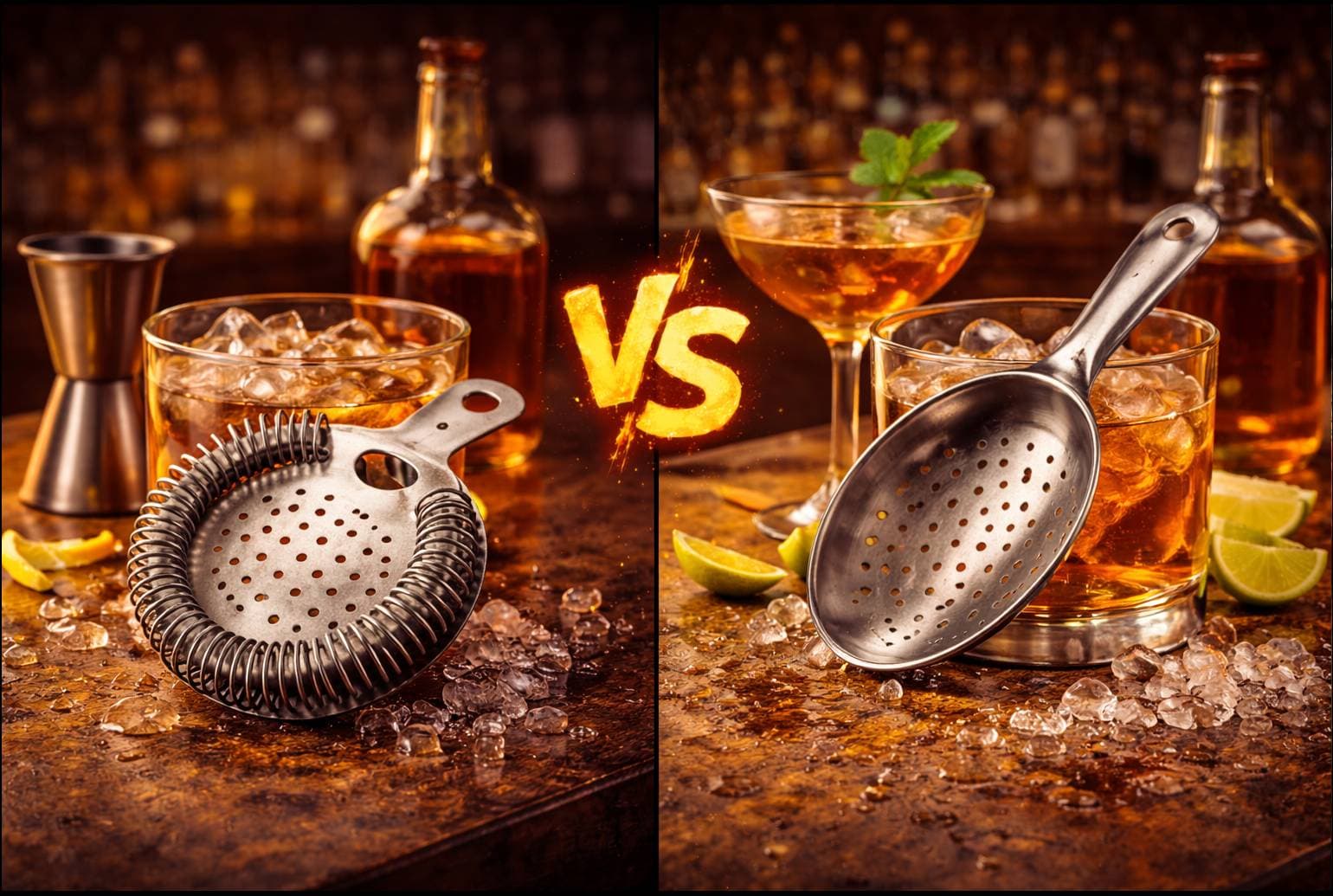
You need a strainer. You search for one and find two different types — a Hawthorne strainer (the one with the spring) and a julep strainer (the perforated spoon-shaped one). They both strain drinks. Do you need both? Does it matter which you use?
It matters more than you'd think, and for reasons most explanations get wrong.
What Each One Does
Both strainers have the same basic job: hold back ice and solid ingredients when you pour a prepared cocktail from a shaker or mixing glass into a serving glass. But they do it differently, and each is designed for a specific vessel and technique.
The Hawthorne strainer is a flat metal disc with a coiled spring attached around its edge. The spring conforms to the inside rim of a shaker tin, creating a snug seal. You press it against the opening with your finger on the tab, tilt, and pour. The spring catches ice, fruit pulp, herb fragments, and ice shards.
The julep strainer is a large perforated spoon — essentially a wide, shallow bowl with holes punched through it. You rest it inside a mixing glass at an angle, concave side facing out, and pour. The perforations let liquid through while holding back ice.
Why Two Strainers Exist
The split isn't arbitrary — it's about which vessel you're pouring from.
Hawthorne strainers are designed for shaker tins. A Boston shaker (the industry standard two-piece metal shaker) has a wide, flat opening. The Hawthorne's spring compresses against the tin's interior wall, creating a tight fit. The spring also acts as a secondary filter — it catches small ice chips and pulp that would slip past a perforated surface.
Shaken drinks need this finer straining because shaking breaks ice into smaller pieces. A vigorous 12-second shake shatters cubes into chips and shards that a julep strainer's relatively large perforations would let through.
Julep strainers are designed for mixing glasses. A mixing glass (typically a wide-mouthed pint glass or Yarai-style glass) has a different shape than a shaker tin — it's wider and tapers differently. A julep strainer's spoon shape naturally seats inside the glass at the right angle.
Stirred drinks don't need as fine a strainer because stirring doesn't break ice. The cubes stay mostly intact, and the julep strainer's perforations are large enough to let the liquid flow freely while catching full-sized cubes. The result is a faster, cleaner pour with less resistance.
What Happens When You Use the Wrong One
Hawthorne in a mixing glass: It works, but the spring doesn't seat as cleanly in most mixing glasses as it does in a shaker tin. You'll get a looser fit, which means you have to press harder with your finger to maintain the seal. It's functional but awkward — the tool isn't shaped for the vessel.
Julep strainer in a shaker tin: This is where it actually goes wrong. A julep strainer sitting in a shaker tin leaves gaps around the edges because the spoon shape doesn't conform to the tin's wide opening. More importantly, the large perforations let ice chips and pulp through — exactly the debris that shaking produces. You end up with ice shards floating in what should be a clean, strained cocktail.
In practice, many home bartenders use only a Hawthorne and make it work for both applications. It's not ideal, but it gets the job done. Professional bartenders almost always use both, because the right tool for the right vessel produces a noticeably cleaner result.
What About a Fine Mesh Strainer?
A fine mesh strainer (sometimes called a tea strainer or double strainer) is a third tool that works alongside either the Hawthorne or julep strainer. You hold it between the shaker/glass and the serving glass, creating a two-stage filtration.
When to double-strain: Any drink where you want an absolutely pristine, chip-free result. Cocktails served "up" (in a coupe or Martini glass with no ice) benefit the most — a single ice shard floating in a Daiquiri looks sloppy. Drinks with muddled ingredients (herbs, fruit) also benefit, since the fine mesh catches tiny particles that even a Hawthorne spring misses.
When it's unnecessary: Drinks served over ice in a rocks glass. The ice in the glass will melt slightly and mask any small chips. A single Hawthorne strain is sufficient for most on-the-rocks drinks.
Which One Should You Buy First?
If you're buying one strainer: Get the Hawthorne. It works with shaker tins (its intended use) and can be pressed into service with mixing glasses in a pinch. It's the more versatile of the two.
If you're buying both: A Hawthorne for shaking and a julep strainer for stirring is the correct pair. Add a fine mesh strainer if you make a lot of drinks served up.
What to look for in a Hawthorne: A tightly coiled spring with dense, close-together coils catches finer debris. Loose, wide-coiled springs let more through. The finger tab should be sturdy and comfortable — you'll be pressing on it with every pour. A slight concavity to the disc helps it seat more securely in the tin.
What to look for in a julep strainer: The holes should be evenly spaced and not too large. The handle should be long enough to rest on the rim of your mixing glass comfortably. Weight matters — a heavier julep strainer stays in place better than a flimsy one.
Check our Bar Tools page for specific recommendations.
The One-Sentence Rule
Hawthorne for shaken drinks. Julep for stirred drinks. Fine mesh for anything served up. That covers every situation you'll encounter at home or behind a bar.
Looking for recipes to practice your straining technique? Browse our cocktail recipes — shaken recipes like the Daiquiri and Margarita use a Hawthorne, while stirred recipes like the Manhattan and Negroni call for a julep strainer.