A bar spoon is a bar spoon, right? It stirs drinks. How different can they be?
Surprisingly different. Japanese and American bar spoons have distinct designs that affect grip, rotation, balance, and even what you can do beyond stirring. Neither is objectively better — but one will feel more natural to you depending on your technique and what you make most often.
The Designs
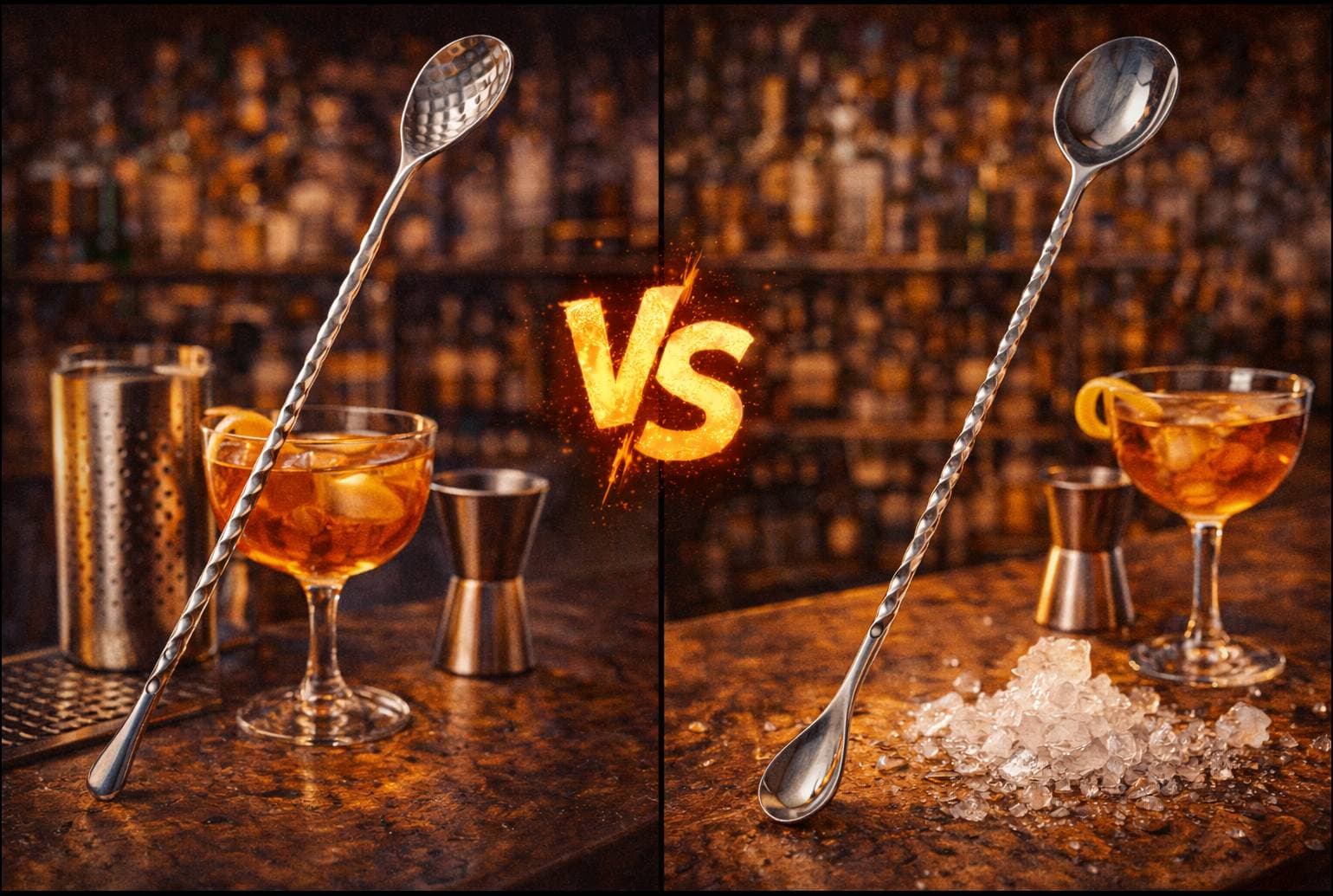
Japanese bar spoons are long (typically 30–40 cm / 12–16 inches), thin, and weighted. The handle is a smooth, tight spiral that tapers toward the spoon bowl. The opposite end usually features a teardrop-shaped counterweight or a small fork for garnishing. The overall design is minimal and precise — no extra material anywhere.
American bar spoons are similar in length but thicker and chunkier. The handle spiral is wider and more pronounced, with a twisted shaft that's designed to be rolled between your fingers. The opposite end often has a flat disc (called a muddler cap) or a simple round tip. The spoon bowl is typically slightly larger than the Japanese version.
European/Continental bar spoons are a third variation worth mentioning — they look similar to American spoons but often have a flat disc or a trident fork on the end. The shaft tends to be somewhere between the Japanese and American in terms of thickness.
How They Stir Differently
The fundamental stirring motion is the same regardless of spoon: you hold the spoon between your middle and ring fingers, press the back of the bowl against the inside wall of the mixing glass, and rotate the spoon in a smooth, continuous circle. The liquid follows the ice around the glass, chilling and diluting evenly.
Where the designs diverge is in how they facilitate that rotation.
Japanese spoons favor a finger-spin technique. The thin, tightly spiraled handle and precise balance point make it easy to spin the spoon between your fingers with minimal wrist movement. The tight spiral gives you tactile feedback about your rotation speed. Experienced bartenders can stir nearly silently — the spoon glides around the glass without clinking against ice. This is the technique you see in Japanese cocktail bars, where stirring is treated as a craft unto itself.
American spoons favor a wrist-roll technique. The thicker handle and wider spiral give you more to grip. Many bartenders hold the upper shaft and twist their wrist to drive the rotation. This is a less refined motion — slightly more forceful, slightly more noise — but it's also more forgiving for beginners. You don't need as much finger dexterity to get a good, even stir.
The practical difference in the finished drink is small. Both techniques achieve the same goal: 20–30 seconds of gentle rotation that chills the drink to roughly 28–30°F with 20–25% dilution. A well-stirred Manhattan made with either spoon tastes the same.
The difference is in how the process feels in your hand — and that's more personal preference than performance.
The Extras on the End
The non-spoon end of a bar spoon varies by style, and this is where practical differences emerge.
Japanese teardrop weight: The weighted end serves as a counterbalance that keeps the spoon stable during rotation. It also doubles as a gentle muddler for light ingredients (expressing citrus oils, lightly pressing herbs). Some bartenders use it to layer drinks — the rounded weight is smooth enough to pour over slowly without disturbing lower layers.
Japanese fork end: Some Japanese spoons have a small two-tined fork instead of the teardrop. It's designed for picking up garnishes — olives, cherries, citrus peels — without using your fingers. Practical in a professional setting where speed and hygiene matter. Less useful at home where you can just use your hand.
American flat disc (muddler cap): The wide, flat end is explicitly designed for muddling. You can press mint, sugar cubes, or fruit directly in the glass before adding spirits and ice. This makes the American spoon a two-in-one tool — stir and muddle with the same implement. If you make a lot of Old Fashioneds (muddling a sugar cube and bitters) or Mojitos (muddling mint), the disc end gets real use.
European trident fork: A three-pronged fork for garnish work. Less common in home bars, more common in European cocktail bars. Functional for spearing olives and cherries but not meaningfully better than the Japanese two-tine version.
Length Matters
Both Japanese and American spoons come in various lengths, but the standard is roughly 30 cm (12 inches). This is long enough to reach the bottom of a standard mixing glass or a Boston shaker tin.
Shorter spoons (20 cm / 8 inches) exist and are marketed as "home bar" sizes. They're harder to use in a tall mixing glass because your hand ends up inside the glass, fighting for space with ice. Avoid them unless you're exclusively stirring in short rocks glasses.
Longer spoons (40 cm / 16 inches) are useful if you're stirring in a tall pitcher or large-format mixing vessel. For standard single or double cocktail preparation, they're more spoon than you need — the extra length just gets in the way.
The right length: If you're stirring in a standard mixing glass or pint glass, 30 cm is correct for either style.
Which One Should You Buy?
Buy a Japanese spoon if:
- You're interested in developing refined stirring technique
- You value a minimal, balanced tool
- You don't need a muddler on your spoon (you have a separate muddler or don't make muddled drinks often)
- You like the aesthetic of Japanese barware
Buy an American spoon if:
- You want a sturdier, more forgiving tool
- You make muddled drinks regularly (Old Fashioneds, Mojitos, Caipirinhas)
- You prefer a thicker grip
- You want a single tool that stirs and muddles
If you're genuinely unsure: Start with a Japanese-style spoon. The balanced design and thinner handle teach you better technique from the start. You can always add a separate muddler later if you need one.
What to avoid: Extremely cheap spoons with rough spiral welds that catch on your fingers, spoons too short for your mixing glass, and novelty spoons with heavy ornamental ends that throw off the balance.
Check our Bar Tools page for specific bar spoon recommendations.
Does It Actually Matter?
For the drink in the glass — barely. A properly stirred cocktail made with either spoon tastes the same.
For the experience of making the drink — yes, noticeably. Stirring is a tactile process. A well-balanced spoon that fits your hand and responds to your fingers makes stirring feel smooth and controlled. A poorly balanced or poorly sized spoon makes it feel clumsy. Since the whole point of upgrading your home bar is to enjoy both the drink and the process of making it, the spoon matters more than its simplicity suggests.
Ready to put your bar spoon to work? Browse our cocktail recipes for stirred classics like the Manhattan, Negroni, and Martini.