Você decidiu que precisa de um refratômetro. Talvez tenha acabado de comprar uma máquina de bebidas congeladas e alguém lhe disse para "verificar o Brix." Talvez esteja preparando coquetéis em lote para uma festa e queira verificar o teor alcoólico.
Aqui está a diferença, quando você precisa de cada um, e se deve comprar um ou ambos.
A Resposta Curta
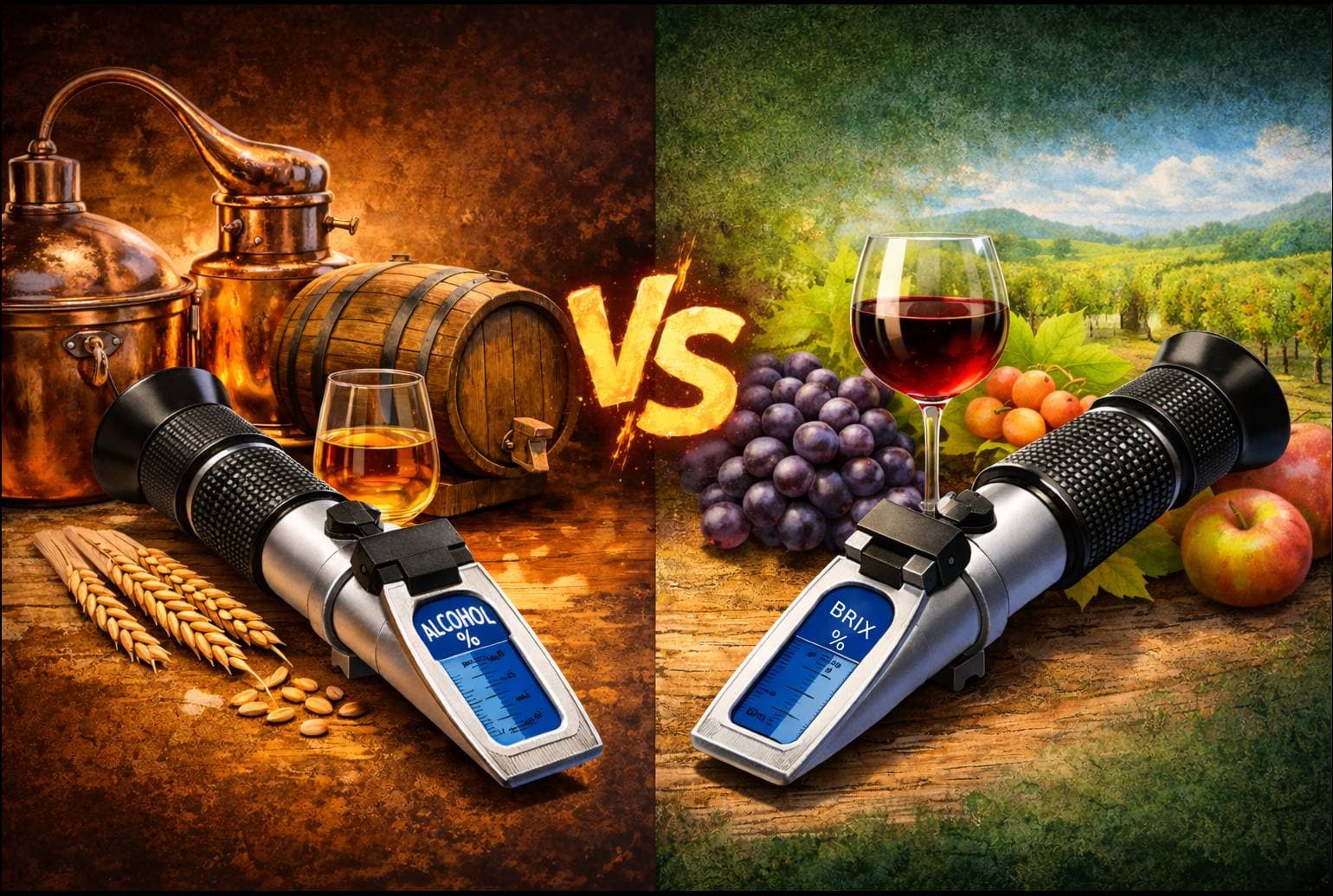
Um refratômetro Brix mede açúcar. Um refratômetro de álcool mede etanol. Eles são quase idênticos visualmente, funcionam da mesma forma (algumas gotas no prisma, leia a escala), mas são calibrados para escalas completamente diferentes. Usar o errado resulta em um número sem significado.
Se você está comprando um refratômetro para uso em máquina de bebidas congeladas, compre o refratômetro Brix. O teor de açúcar é o que determina se seu lote congela na consistência certa ou danifica sua máquina.
Se você está fazendo qualquer tipo de infusão de destilados ou quer verificar o teor alcoólico da garrafa, adicione um refratômetro de álcool. Modelos ópticos básicos de cada tipo não são caros, então ter ambos não é um grande investimento.
O Que um Refratômetro Brix Mede
Brix (°Bx) é uma escala que mede o conteúdo de açúcar dissolvido em um líquido. Um grau Brix equivale a um grama de sacarose por 100 gramas de solução. Quando você coloca algumas gotas no prisma e olha através da ocular (ou lê o display digital), obtém um número que indica que porcentagem daquele líquido é açúcar.
Para coquetéis congelados, esse número é tudo. Máquinas de bebidas congeladas — sejam unidades comerciais como Spaceman & Elmeco ou máquinas domésticas como Ninja SLUSHi — precisam que o lote esteja entre 13–18 Brix para produzir uma textura congelada adequada. Abaixo de 13, a mistura congela sólida e pode danificar a máquina. Acima de 18, não congela.
Leituras Brix comuns para ingredientes de coquetel:
| Ingrediente | Brix Aproximado |
|---|---|
| Água | 0 |
| Suco de limão ou lima fresco | 7 |
| Suco de laranja fresco | 11 |
| Suco de abacaxi | 14 |
| Xarope simples (1:1) | 50 |
| Xarope simples rico (2:1) | 65 |
| Grenadine | 55 |
| Triple sec / Cointreau | 25 |
| Kahlua | 45 |
| Amaretto | 40 |
| Todos os destilados puros | 0 |
Note a última linha — destilados puros (vodka, gin, rum, whiskey, tequila) não contêm açúcar e têm Brix verdadeiro de 0. Mas aqui é onde fica complicado.
O Problema do Álcool com Refratômetros Brix
O etanol tem um índice de refração mais alto que a água. Quando você coloca um lote de coquetel rico em destilado em um refratômetro Brix, o álcool curva a luz de uma forma que parece açúcar dissolvido para o instrumento. O resultado é uma leitura Brix falsamente elevada.
Se você medir um lote rico em vodka em um refratômetro Brix óptico, pode mostrar 8–10 Brix quando o teor real de açúcar é muito menor. Isso pode levá-lo a pensar que seu lote está na zona segura quando na verdade está muito baixo em açúcar e corre risco de congelar sólido.
Refratômetros Brix digitais com algoritmos de compensação de álcool lidam melhor com isso, mas também não são perfeitos. A conclusão: refratômetros Brix são mais precisos em soluções onde o açúcar é o principal sólido dissolvido — sucos, xaropes, lotes pré-misturados com álcool moderado. Para lotes de alto teor alcoólico e baixo açúcar, considere algum desvio para cima na leitura.
O Que um Refratômetro de Álcool Mede
Um refratômetro de álcool mede concentração de etanol por volume, expressa como % v/v (volume por volume). Esta é a mesma medição que o teor alcoólico. Quando uma garrafa de bourbon diz "45% de teor alcoólico," significa que 45% do volume do líquido é etanol puro. Um refratômetro de álcool lê isso diretamente em uma escala de 0–80% v/v.
Por que isso importa para lotes: quando você está fazendo coquetéis congelados, precisa saber duas coisas — o teor de açúcar (Brix) e o teor alcoólico (% v/v). Brix indica se o lote vai congelar na textura certa. O teor alcoólico indica se o lote vai congelar de qualquer forma. O álcool reduz o ponto de congelamento independentemente do açúcar, e um lote acima de 10% de teor alcoólico terá dificuldades na maioria das máquinas domésticas, independentemente do Brix.
Para lotes congelados, seu teor alcoólico alvo para o lote final misturado é 5–10%.
O Problema do Açúcar com Refratômetros de Álcool
Assim como o álcool confunde refratômetros Brix, o açúcar confunde refratômetros de álcool. Refratômetros de álcool são calibrados para soluções de etanol e água apenas. Eles produzem leituras precisas em destilados puros e diluições de destilado-água. Eles não são precisos em coquetéis contendo açúcar, suco, creme ou outros sólidos dissolvidos.
Um lote de margarita com suco de lima e triple sec dará uma leitura v/v enganosa porque o açúcar e o ácido cítrico alteram o índice de refração. O instrumento interpreta a refração extra como álcool, produzindo uma leitura mais alta que o teor alcoólico real.
Isso significa que você não pode usar um refratômetro de álcool para verificar o teor alcoólico de um lote de coquetel finalizado. Para isso, calcule o teor alcoólico a partir das proporções da receita (MixologyRecipe faz isso automaticamente em nossas páginas de receitas em lote).
Quando Usar Qual
| O Que Você Está Verificando | Use Isto | Por Que |
|---|---|---|
| Teor de açúcar de um lote congelado antes de colocar na máquina | Refratômetro Brix | Mede diretamente o açúcar dissolvido — o número que sua máquina precisa |
| Teor alcoólico de um destilado puro ou infusão de destilado | Refratômetro de álcool | Solução etanol-água sem açúcar para interferir |
| Teor alcoólico de um lote de coquetel finalizado | Calcular da receita | Açúcar, suco e creme confundem ambos os tipos de refratômetro |
| Um lote comercial pré-misturado (ex: mix de margarita comprado) | Refratômetro Brix | Misturas comerciais são padronizadas — Brix é a métrica relevante |
| Verificando uma garrafa de limoncello caseiro ou destilado infundido | Refratômetro de álcool | Infusões de destilado são principalmente etanol e água |
| Verificando se seu xarope simples é realmente 1:1 | Refratômetro Brix | Deve ler aproximadamente 50 Brix |
E Quanto a Dispositivos Que Leem Ambos?
Alguns refratômetros digitais podem ler tanto Brix quanto álcool potencial da mesma amostra. O Hanna HI96813 lê tanto % Brix quanto álcool potencial (% v/v) digitalmente. É preciso, rápido e elimina a necessidade de dois instrumentos separados.
O Milwaukee MA884 também lê tanto Brix (faixa 0–50%) quanto álcool potencial (0–25% v/v), com compensação de temperatura e tempo de leitura de 2 segundos.
Esses dispositivos de dupla função são convenientes, mas entenda que a leitura de "álcool potencial" é uma estimativa derivada do índice de refração — funciona bem em soluções simples mas tem as mesmas limitações que um refratômetro de álcool independente em misturas complexas de coquetel.
Óptico vs. Digital — Uma Comparação Rápida
Tanto refratômetros Brix quanto de álcool vêm em versões ópticas (visor) e digitais.
Modelos ópticos são instrumentos analógicos. Você coloca gotas no prisma, segura contra uma fonte de luz e lê a escala através da ocular. Não precisam de baterias e funcionam perfeitamente para uso ocasional. A desvantagem é que as leituras dependem da sua visão e condições de iluminação.
Modelos digitais mostram um número numa tela LCD. São mais rápidos, mais precisos (tipicamente mais ou menos 0,2%) e funcionam em qualquer iluminação. Se você faz lotes frequentemente — para um bar, food truck ou serviço de catering — a atualização digital se paga em velocidade e consistência.
Para a maioria dos usuários domésticos fazendo lotes para festas, um par de refratômetros ópticos (um Brix, um álcool) é o ponto de partida inteligente.
Nossas Recomendações
Melhor ponto de partida — apenas Brix: Um refratômetro Brix ATC (faixa 0–32%) com compensação automática de temperatura. Modelos ópticos básicos indicam tudo que você precisa saber antes de colocar um lote na sua máquina. Veja nossas escolhas na página de Ferramentas do Bar
Melhor combo para entusiastas de lotes: Adicione um refratômetro de álcool ATC (0–80% v/v). Agora você pode verificar tanto teor de açúcar quanto de destilado. Página de Ferramentas do Bar
Melhor dispositivo único: O Hanna HI96813 lê tanto Brix quanto álcool potencial digitalmente. Um dispositivo, duas medições, sem apertar os olhos na ocular.
Melhor para uso profissional/diário: O Atago PAL-1 é o refratômetro Brix digital padrão da indústria — à prova d'água IP65, faixa 0–53%, usado por bares e empresas de bebidas mundialmente. Detalhes completos do produto
Conclusão
Se você tem uma máquina de bebidas congeladas, precisa de um refratômetro Brix. Ponto final. É a ferramenta que indica se seu lote vai congelar corretamente ou destruir sua máquina. Um refratômetro de álcool é uma adição útil — especialmente para trabalho de infusão e verificação de destilados — mas é secundário para a maioria dos bartenders domésticos.
Não complique. Um refratômetro Brix óptico e um entendimento básico da faixa 13–18 Brix vai salvá-lo de 90% das falhas de coquetéis congelados.
Para mais sobre Brix, como funciona, e um guia passo a passo para usar seu refratômetro, leia nosso artigo complementar: O Que É Brix e Como Verificá-lo Usando um Refratômetro.
Navegue em nossas receitas de coquetéis em lote para receitas testadas de 1 galão com estimativas de Brix e teor alcoólico já calculadas.
MixologyRecipe.com fornece valores estimados de Brix e estimativas de teor alcoólico para fins educacionais. Sempre verifique com um refratômetro devidamente calibrado antes de adicionar qualquer mistura a uma máquina de bebidas congeladas. Veja nosso aviso completo para detalhes.