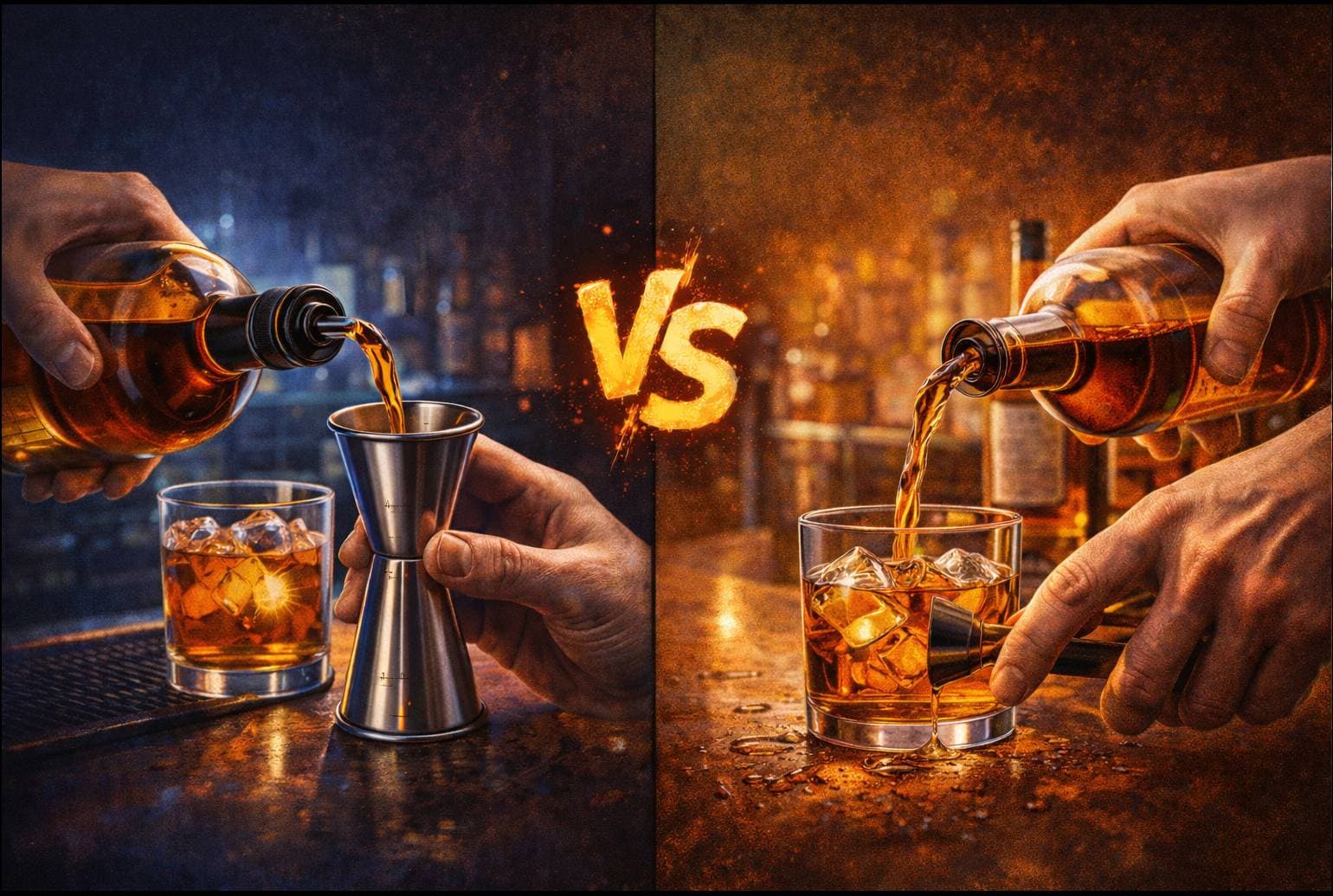
Every home bartender has the same debate at some point: do I really need a jigger, or can I just eyeball it? The short answer is that free pouring is less accurate than almost everyone thinks it is, and the difference between a great cocktail and a mediocre one often comes down to a quarter ounce.
Here's why a jigger is the single most important tool in your bar — including why professional bartenders who free pour still know how to use one.
The Free Pour Accuracy Problem
Free pouring is the technique of counting in your head while pouring from a bottle fitted with a speed pour spout. The standard method is a "four count" — counting to four at a steady rhythm produces roughly 1.5 oz (a standard jigger). Faster counts or slower pours adjust the volume up or down.
It looks effortless when an experienced bartender does it. It feels natural. And it's consistently less accurate than people believe.
Studies on bartender pouring accuracy have found that free pouring is typically off by 20–30% from the intended volume. Even experienced bartenders who free pour daily show meaningful variation between pours. The error is worst with smaller quantities — a quarter-ounce pour of something like absinthe or bitters is nearly impossible to nail consistently without measuring.
That 20–30% error might not sound like much, but cocktails are built on ratios. A classic Daiquiri is 2 oz white rum, 1 oz fresh lime juice, ¾ oz simple syrup. If your lime juice pour is 30% over (1.3 oz instead of 1 oz), the drink shifts from balanced to noticeably tart. If your syrup pour is 30% under (about ½ oz instead of ¾ oz), the drink becomes thin and acidic. Now multiply those errors across three or four ingredients, and the cocktail you're making barely resembles the recipe you're following.
Why Ratios Matter More Than Recipes
A cocktail recipe isn't a list of ingredients — it's a set of ratios. The Margarita is a 2:1:1 ratio (tequila to lime to orange liqueur). The Whiskey Sour is a 2:1:¾ ratio (whiskey to lemon to syrup). The Manhattan is a 2:1 ratio (whiskey to sweet vermouth) with bitters.
These ratios were developed and refined over decades (in some cases, over a century) to produce a specific flavor balance — the interplay between spirit strength, citrus acidity, sweetness, and dilution. When you change the ratio, even slightly, you change the drink.
This is why two people can follow the same recipe and get different results. One is measuring precisely; the other is free pouring and unknowingly making a different drink.
What a Jigger Actually Does
A jigger is a double-sided measuring cup, typically with one side measuring 1.5 oz (a standard "jigger") and the other measuring 0.75 oz (a "pony"). Modern jiggers come in several styles, but they all do the same thing: give you a consistent, repeatable volume.
The Japanese-style jigger is taller and narrower than the traditional hourglass shape, which makes it easier to read smaller measurements. Most Japanese jiggers have etched interior lines marking ¼ oz, ½ oz, ¾ oz, 1 oz, 1.5 oz, and 2 oz — making a single tool cover virtually every measurement in cocktail making.
The OXO-style angled jigger has measurement lines visible from above, so you don't need to hold it at eye level to check the fill. This is convenient for beginners but slightly less precise at very small volumes.
The bell jigger is a compromise between the traditional shape and the Japanese style — wider at the rim for easy pouring, tapered for accurate reads.
Regardless of style, any jigger eliminates the 20–30% variance of free pouring and replaces it with a measurement that's accurate to within a few milliliters every time.
The "But Professional Bartenders Free Pour" Argument
They do. And there are good reasons for it — speed being the main one. When you're making 200 cocktails in a shift, shaving two seconds per drink adds up. High-volume bars optimize for throughput, and an experienced bartender who has practiced their four-count thousands of times can free pour within an acceptable tolerance for most drinks.
But notice the qualifiers: experienced, practiced thousands of times, acceptable tolerance, most drinks. Professional bartenders who free pour have built muscle memory through repetition over years. They also tend to work with a smaller, memorized menu where the ratios are second nature.
Even in professional settings, many top cocktail bars — especially those focused on craft cocktails rather than volume — use jiggers for every drink. Japanese-style cocktail bars are famously precise, and many award-winning bartenders in the craft cocktail world jigger every pour. The reasoning is simple: if you're charging $18 for a cocktail, it should taste exactly the same every time a guest orders it.
For home bartenders making drinks a few times a week, free pouring accuracy never gets a chance to develop. A jigger skips the learning curve entirely.
Where Precision Matters Most
Not every ingredient is equally sensitive to measurement error. Here's where getting it right matters most:
Citrus juice is the most unforgiving ingredient in cocktail making. A quarter ounce too much lime or lemon juice will noticeably sharpen the drink. A quarter ounce too little makes it flat. Citrus is where free pour errors show up first and most obviously.
Sweetener is the counterbalance to citrus. Simple syrup, agave, honey syrup — these need to match the acid precisely. Too much sweetener and the drink is cloying. Too little and the citrus dominates. This is why sour-style cocktails (Daiquiri, Margarita, Whiskey Sour) are the hardest to free pour well — both the acid and the sweet need to be right.
High-proof spirits amplify errors. An extra quarter ounce of overproof rum or cask-strength bourbon changes the character of the drink more than the same error with an 80-proof spirit. The alcohol heat becomes more prominent, and the balance shifts toward boozy.
Liqueurs and modifiers are where small volumes make big differences. A quarter ounce of Campari, a barspoon of absinthe, a dash of maraschino — these are flavor accents, not base ingredients. Overpouring them dominates the drink. Free pouring a half-ounce modifier accurately is extremely difficult.
Bitters are essentially impossible to free pour with any consistency. Use the dasher top on the bottle and count your dashes. One dash is roughly ⅛ teaspoon.
The Batch Cocktail Connection
If precise measurement matters for a single drink, it matters exponentially for batch cocktails. When you're scaling a recipe to a gallon for a party or a frozen drink machine, every measurement error multiplies by the batch factor.
A quarter-ounce surplus of lime juice in a single Margarita is a minor imbalance. That same proportional error in a 1-gallon batch means your entire batch — 20+ servings — is off. You can't fix it by tasting one glass and adjusting, because the whole batch is already mixed.
This is why our batch recipes specify ingredients to the ounce and include Brix estimates — so you can verify the sugar balance with a refractometer before committing the batch to your machine.
Which Jigger Should You Buy?
You don't need to overthink this. Here's what works:
For most people: A Japanese-style jigger (2 oz / 1 oz) with interior measurement lines. The tall, narrow shape is precise, the interior markings let you hit ¼ oz increments, and it looks good on a bar.
For beginners who want easy reads: An OXO angled jigger lets you see the measurement from above without bending down. It's less elegant but more practical if you're learning.
For anyone who hates jiggers: A graduated measuring cup (like a mini glass beaker with ml and oz markings) gives you jigger accuracy with the familiarity of a kitchen measuring cup. You lose the speed of a jigger pour, but you gain easy reads at any increment. Around.
What not to buy: Avoid novelty jiggers, shot glasses marketed as jiggers (they're rarely accurate), and extremely cheap jiggers with poorly defined measurement lines. The inside markings should be etched or raised, not just printed — printed lines wear off quickly.
Check out our Bar Tools page for specific recommendations and links.
The One Habit That Changes Everything
If you take one thing from this article, make it this: measure your citrus. You can free pour spirits reasonably well with practice. You can approximate sweetener and adjust to taste. But citrus — lime juice, lemon juice — is the ingredient that makes or breaks sour-style cocktails, and it's the ingredient most people get wrong.
Start measuring your citrus with a jigger, and your cocktails will improve immediately. Once you see the difference, you'll probably start measuring everything else too.
Looking for recipes to test your newly precise pours? Browse our cocktail recipes or try our Ingredient Matcher to find drinks you can make with what you have.