Most cocktail recipes call for "simple syrup" without specifying which kind. But the two standard versions — 1:1 and 2:1 — differ enough to change how a drink tastes, its mouthfeel, and whether a frozen batch freezes properly.
The Two Standards
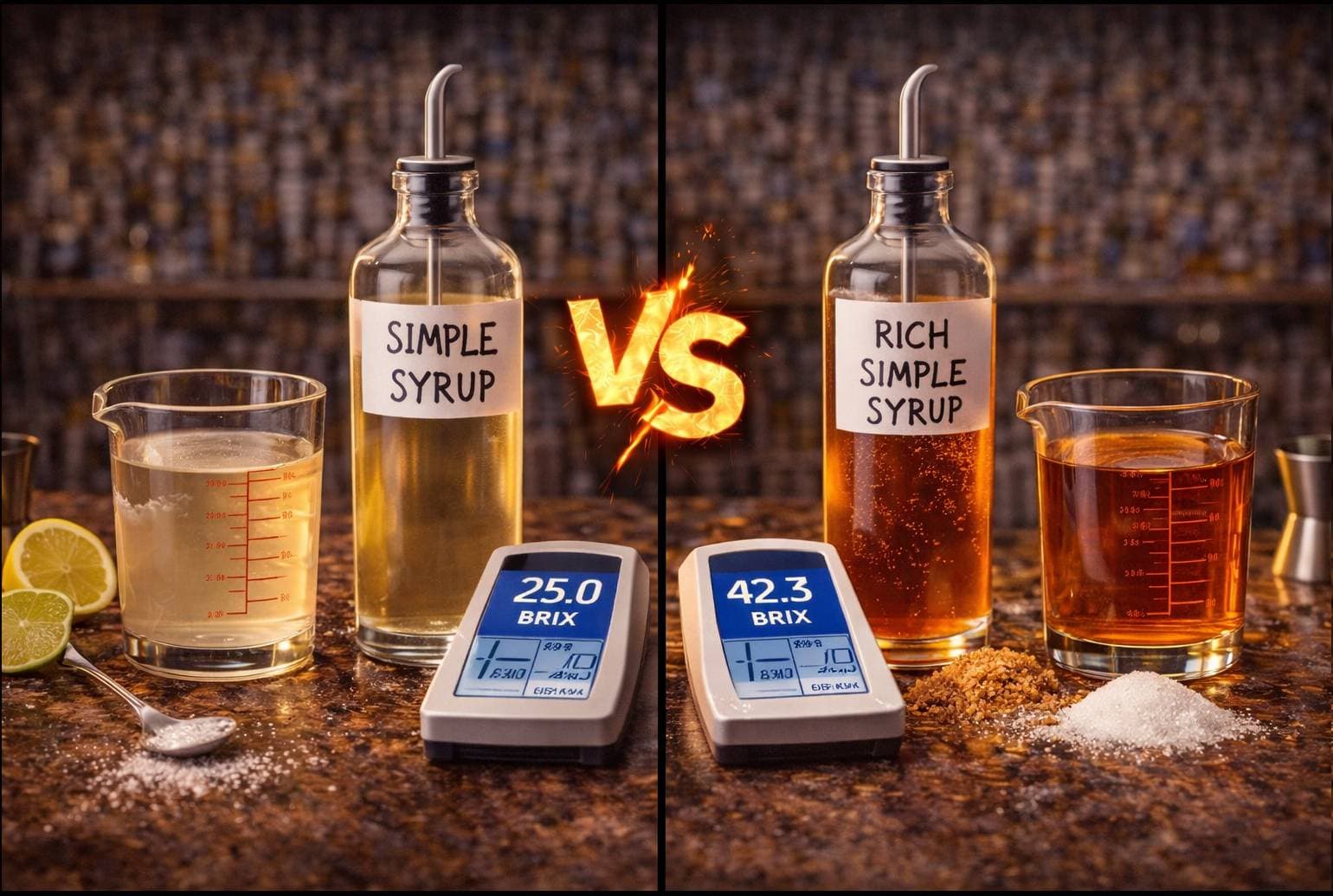
Simple syrup (1:1) is equal parts sugar and water by weight. One cup of sugar dissolved in one cup of water. It's thin, pourable, and integrates quickly into cold drinks. It has a Brix of approximately 50 — meaning 50% of the solution is dissolved sugar.
Rich simple syrup (2:1) is two parts sugar to one part water by weight. Two cups of sugar dissolved in one cup of water. It's noticeably thicker and more viscous — almost like a light honey. It has a Brix of approximately 65.
Both dissolve cleanly into cocktails. The differences are in sweetness concentration, mouthfeel, shelf life, and how they interact with Brix in frozen batches.
Sweetness Per Volume
This is the most immediately practical difference. Rich syrup is sweeter per unit of volume because it contains more sugar and less water in the same amount of liquid.
If a recipe calls for ¾ oz of 1:1 simple syrup and you substitute ¾ oz of 2:1 rich syrup, the drink will be noticeably sweeter. The extra sugar in the rich syrup adds roughly 30% more sweetness to the same volume.
The conversion: To substitute rich syrup for simple syrup, use about two-thirds the amount. ¾ oz of 1:1 simple = ½ oz of 2:1 rich. 1 oz of 1:1 simple ≈ ⅔ oz of 2:1 rich.
To go the other direction: If a recipe calls for rich syrup and you only have 1:1, use about one and a half times the amount. ½ oz of 2:1 rich ≈ ¾ oz of 1:1 simple.
These conversions aren't exact — they get you in the right ballpark, and your palate handles the fine-tuning.
Mouthfeel and Texture
Rich syrup adds a subtle viscosity to cocktails that 1:1 syrup doesn't. The higher sugar concentration creates a slightly silkier, rounder mouthfeel — the drink coats the tongue just a little more. This is noticeable in spirit-forward cocktails where there aren't many other ingredients competing for attention.
An Old Fashioned made with 2:1 rich syrup feels more substantial than one made with 1:1. The spirit is the same, the bitters are the same, but the textural contribution of the sweetener is different. Some bartenders prefer this heavier mouthfeel. Others find it too thick.
In shaken, citrus-forward drinks (Daiquiris, Margaritas, Whiskey Sours), the difference in mouthfeel is much less noticeable. The citrus acid, the dilution from shaking, and the aeration all mask the viscosity difference. For these drinks, either syrup works — just adjust the volume.
Dilution Control
Here's where the choice gets strategic, especially for stirred cocktails.
When you use 1:1 simple syrup, half of what you're adding is water. In a stirred Old Fashioned where dilution matters, that extra water adds to the total dilution — on top of the water from ice melt during stirring.
Rich syrup contributes more sweetness per ounce with less water. This means less total dilution in the finished drink. For cocktails where you want the spirit character to stay concentrated — a big, bold Old Fashioned, a Sazerac, a Vieux Carré — rich syrup lets you sweeten the drink without thinning it.
This is why many craft cocktail bars default to 2:1 rich syrup for stirred drinks and 1:1 simple for shaken drinks. The stirred drinks benefit from the reduced dilution. The shaken drinks already have plenty of dilution from shaking, so the extra water in 1:1 syrup doesn't matter.
Shelf Life
Rich syrup lasts significantly longer in the refrigerator than 1:1 syrup.
1:1 simple syrup lasts about 2–3 weeks refrigerated. After that, you'll often see cloudiness or mold starting to form. The relatively high water content makes it a hospitable environment for microorganisms.
2:1 rich syrup lasts 1–2 months refrigerated. The higher sugar concentration acts as a preservative — the same principle that makes honey shelf-stable. Some bartenders add a small amount of vodka (½ oz per cup of syrup) to extend the shelf life further.
For both: Store in a clean glass bottle or jar with a tight-fitting lid. Label it with the date you made it. When in doubt, make a fresh batch — the ingredients cost almost nothing and it takes 5 minutes.
How to Make Each One
Both are dead simple. You don't even need to cook.
1:1 Simple Syrup (Hot Method): Combine equal parts sugar and water by weight in a saucepan. Heat over medium, stirring, until the sugar dissolves completely. Don't let it boil — boiling can start to caramelize the sugar, which changes the flavor. Remove from heat, let it cool, and transfer to a bottle.
1:1 Simple Syrup (Cold Method): Combine equal parts sugar and water in a jar. Shake vigorously for about 2 minutes until the sugar dissolves. Superfine sugar dissolves faster than granulated. This method avoids any heat and produces a cleaner, more neutral-tasting syrup.
2:1 Rich Simple Syrup: Combine 2 parts sugar to 1 part water by weight in a saucepan. Heat over medium-low, stirring constantly, until dissolved. Rich syrup typically requires heat — the higher sugar concentration won't dissolve easily in room-temperature water. Don't boil. Cool and bottle.
Demerara syrup: A popular variation using demerara sugar (raw, partially refined) instead of white sugar. It adds a subtle molasses and caramel note that works particularly well with aged spirits — bourbon, rye, rum. Make it at 2:1 ratio the same way as rich simple. Brix is approximately 65, same as white sugar rich syrup. Used in many modern Old Fashioned recipes.
How This Affects Brix in Frozen Batches
This is where the choice between 1:1 and 2:1 has measurable consequences for frozen drink machines.
1:1 simple syrup has a Brix of approximately 50. Rich syrup has a Brix of approximately 65. When you're formulating a frozen batch that needs to land in the 13–18 Brix range for proper machine freezing, the syrup you use changes how much you need.
Because rich syrup is more concentrated, you need less of it to reach the same Brix target — but you also add less water to the batch, which affects the total volume and the ABV calculation.
Example: A frozen Daiquiri batch needs sweetener to bring it into the 13–18 Brix range. If you use 1:1 simple syrup, you might need 10 oz per gallon. That 10 oz contributes 5 oz of sugar and 5 oz of water. If you use 2:1 rich syrup, you might need 7 oz to reach the same sweetness — but that 7 oz contributes roughly the same sugar with only 2.3 oz of water. The rich syrup batch will have a slightly higher ABV (less total water) and potentially different texture.
For frozen batches, always check your Brix with a refractometer after mixing, regardless of which syrup you use. The math gets you close; the refractometer tells you where you actually landed. For more on Brix and frozen drinks, see: What Is Brix and How to Check It.
Other Sweeteners and Their Brix
Simple and rich simple aren't your only options. Here's how other common cocktail sweeteners compare:
| Sweetener | Approximate Brix | Notes |
|---|---|---|
| Simple syrup (1:1) | 50 | Standard, neutral sweetness |
| Rich simple syrup (2:1) | 65 | Thicker, longer shelf life |
| Demerara syrup (2:1) | 65 | Caramel/molasses notes, pairs with aged spirits |
| Honey syrup (1:1) | 40 | Honey flavor, slightly lower Brix than sugar syrups |
| Agave nectar | 75 | Very concentrated, use sparingly |
| Grenadine | 55 | Pomegranate flavor, not just sweetener |
| Orgeat | 55 | Almond flavor, essential for Mai Tais |
For frozen batches, higher-Brix sweeteners (agave, rich syrup) give you more sugar per ounce, which means you can hit your Brix target with less total volume of sweetener. Lower-Brix sweeteners (honey syrup) require more volume to reach the same target, which adds more water to the batch.
The Quick Decision
Use 1:1 simple syrup when: You're making shaken drinks, you want a thinner texture, or the recipe specifically calls for it. It's the safe default for most cocktails.
Use 2:1 rich simple syrup when: You're making stirred spirit-forward drinks (Old Fashioned, Sazerac), you want less dilution, you want a silkier mouthfeel, or you want syrup that lasts longer in the fridge.
When it doesn't matter much: In heavily flavored cocktails with multiple ingredients (Tiki drinks, complex sours), the difference between 1:1 and 2:1 is masked by everything else going on. Just adjust the volume and move on.
Looking for recipes to test both syrups? Browse our cocktail recipes — try a Daiquiri with 1:1 for the classic version, then an Old Fashioned with 2:1 rich for the contrast. Or explore our batch recipes where syrup choice directly affects Brix and freeze quality.