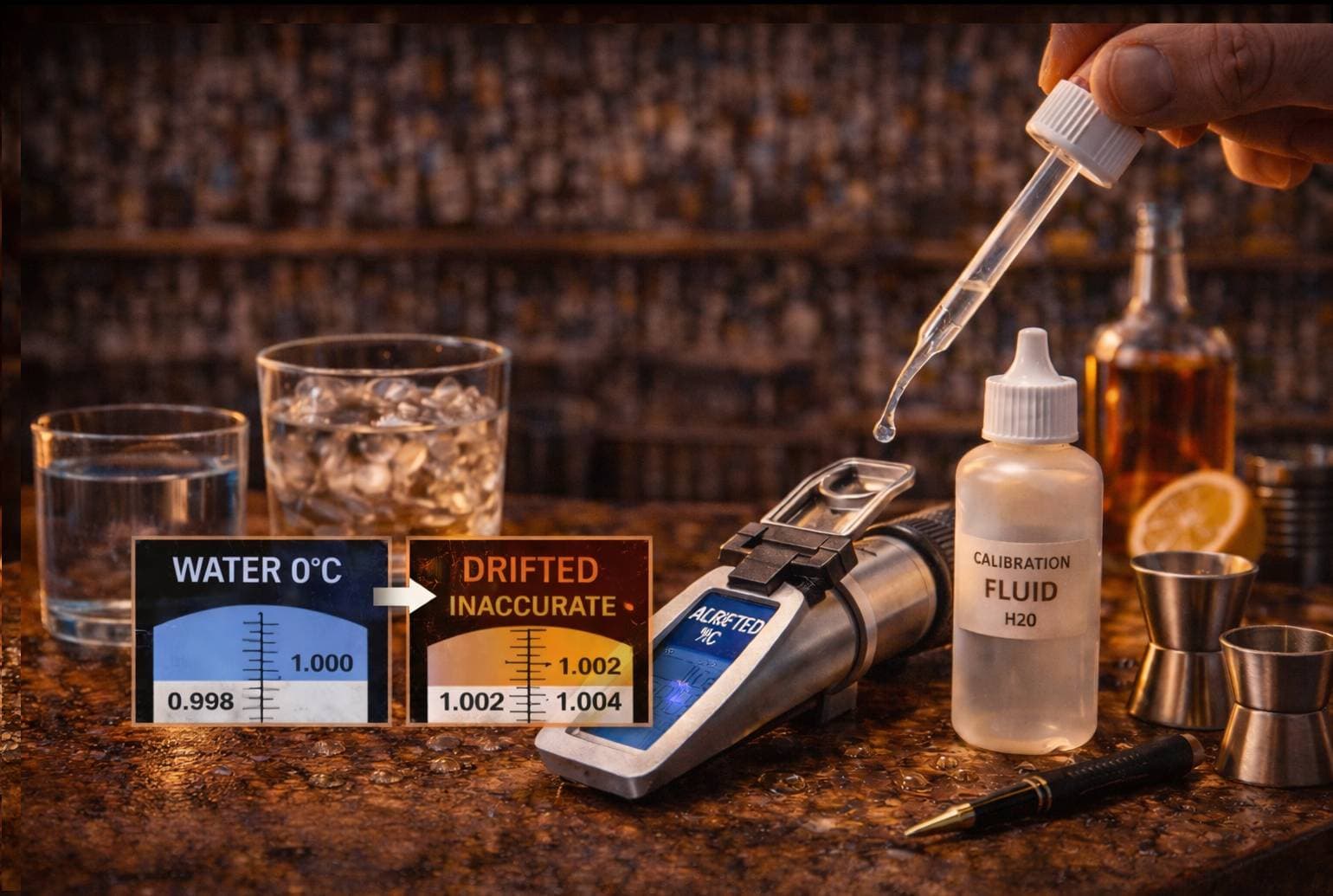
Ein Refraktometer ist nur so gut wie seine Kalibrierung. Wenn der Nullpunkt auch nur um 1°Bx abweicht, ist jede Messung, die Sie durchführen, um denselben Betrag falsch — und bei Frozen-Drink-Maschinen, wo der ideale Brix-Bereich 13–18 liegt, kann ein 2°Bx-Fehler den Unterschied zwischen einem perfekten Slush und einem festen Eisblock ausmachen.
Die Kalibrierung dauert etwa 30 Sekunden. Hier erfahren Sie, wie Sie sie durchführen, warum Ihr Refraktometer mit der Zeit driftet und wie oft Sie nachkalibrieren sollten.
So kalibrieren Sie ein optisches Refraktometer
Optische (Sichtglas-)Refraktometer haben eine kleine Kalibrierungsschraube, die sich normalerweise oben am Instrument in der Nähe des Okulars befindet. Der Vorgang ist einfach:
Schritt 1: Besorgen Sie destilliertes Wasser. Nicht Leitungswasser, nicht gefiltertes Wasser — destilliertes. Leitungswasser enthält gelöste Mineralien, die als kleine Brix-Messung registriert werden. Sie finden destilliertes Wasser in jedem Supermarkt für ein paar Euro. Ein einzelner Liter reicht für Jahre von Kalibrierungen.
Schritt 2: Öffnen Sie die Tageslichtplatte und geben Sie 2–3 Tropfen destilliertes Wasser auf das Prisma. Schließen Sie die Platte, um das Wasser gleichmäßig zu verteilen.
Schritt 3: Halten Sie das Refraktometer gegen eine Lichtquelle und schauen Sie durch das Okular. Sie sollten die Skala mit einer Trennlinie zwischen einer blauen Zone und einer weißen Zone sehen.
Schritt 4: Die Trennlinie sollte genau bei 0,0 auf der Brix-Skala liegen. Wenn ja, sind Sie fertig — Ihr Refraktometer ist kalibriert.
Schritt 5: Wenn die Linie über oder unter 0,0 liegt, verwenden Sie einen kleinen Schlitzschraubendreher, um die Kalibrierungsschraube zu drehen. Drehen Sie sie langsam — kleine Anpassungen bewegen die Skala erheblich. Schauen Sie nach jeder Vierteldrehung durch das Okular, bis die Linie genau bei 0,0 liegt.
Schritt 6: Wischen Sie das Prisma mit einem weichen, feuchten Tuch sauber. Sie sind bereit zum Messen.
So kalibrieren Sie ein digitales Refraktometer
Digitale Refraktometer haben einen Kalibrierungsknopf oder eine Menüfunktion anstelle einer Schraube. Der Vorgang variiert je nach Modell leicht, aber die allgemeinen Schritte sind:
Schritt 1: Geben Sie 2–3 Tropfen destilliertes Wasser in die Sensorvertiefung.
Schritt 2: Drücken Sie den Kalibrierungsknopf (oft mit "CAL" oder "ZERO" beschriftet). Das Display blinkt oder zeigt eine Kalibrierungsanzeige.
Schritt 3: Warten Sie, bis das Display bestätigt, dass die Kalibrierung abgeschlossen ist. Die meisten digitalen Modelle benötigen 2–3 Sekunden.
Schritt 4: Das Display sollte nun 0,0 Brix anzeigen. Wenn nicht, wiederholen Sie den Vorgang. Wenn es sich immer noch nicht auf Null stellt, reinigen Sie den Sensor gründlich — Rückstände auf dem Prisma sind die häufigste Ursache für fehlgeschlagene Kalibrierung.
Schritt 5: Wischen Sie den Sensor sauber. Bereit zum Messen.
Einige hochwertigere digitale Modelle wie das Hanna HI96813 haben eine spezielle Kalibrierungs-Standardlösung (eine kleine Flasche mit Flüssigkeit mit bekanntem Brix-Wert), die Sie anstelle von destilliertem Wasser für eine noch präzisere Kalibrierung verwenden können. Wenn Ihr Modell mit Kalibrierungslösung geliefert wurde, verwenden Sie sie gemäß den Herstelleranweisungen.
Warum Ihr Refraktometer driftet
Refraktometer bleiben nicht für immer perfekt kalibriert. Mehrere Faktoren verursachen mit der Zeit eine Verschiebung des Nullpunkts:
Temperaturänderungen. Der Brechungsindex einer Flüssigkeit ändert sich mit der Temperatur. Die meisten Cocktail-tauglichen Refraktometer enthalten ATC (automatische Temperaturkompensation), die dies in einem vernünftigen Bereich korrigiert (normalerweise 10–30°C). Aber extreme Temperaturschwankungen — das Refraktometer in einem heißen Auto zu lassen und es dann in eine klimatisierte Küche zu bringen — können auch mit ATC vorübergehend die Messwerte durcheinanderbringen. Lassen Sie das Instrument ein paar Minuten akklimatisieren, bevor Sie kalibrieren.
Rückstandsanhäufung. Klebrige Cocktailzutaten (einfacher Sirup, Grenadine, Fruchtsaft) hinterlassen Rückstände auf dem Prisma, wenn Sie nach jeder Verwendung nicht gründlich reinigen. Mit der Zeit bilden diese Rückstände einen dünnen Film, der die Messwerte nach oben verschiebt. Das Refraktometer "sieht" die Rückstände als gelösten Zucker und fügt sie zu jeder nachfolgenden Messung hinzu.
Mechanischer Verschleiß (nur optisch). Die Kalibrierungsschraube an einem optischen Refraktometer kann sich mit der Zeit leicht lockern, besonders wenn das Instrument in einer Schublade oder Barwerkzeugtasche herumgeschüttelt wird. Deshalb benötigen optische Modelle regelmäßige Nachkalibrierung — die Schraube bewegt sich physisch.
Prismenschäden. Kratzer auf der Prismenoberfläche streuen Licht ungleichmäßig und verschlechtern die Messgenauigkeit. Wischen Sie immer mit einem weichen Tuch, niemals mit Papiertüchern oder scheuernden Materialien. Ein verkratztes Prisma kann nicht nachkalibriert werden — es muss ersetzt werden.
Batterie- und Sensoralterung (nur digital). Digitale Refraktometer verwenden LED-Lichtquellen und Fotodetektoren, die mit der Zeit sehr leicht driften können. Deshalb profitieren digitale Modelle von regelmäßiger Nachkalibrierung, obwohl sie keine mechanische Schraube haben.
Wie oft sollten Sie kalibrieren?
Vor Ihrer ersten Messung jeder Sitzung. Wenn Sie dabei sind, Cocktails zu batchen, nehmen Sie sich 30 Sekunden Zeit, um Ihr Refraktometer mit destilliertem Wasser zu nullen, bevor Sie mit dem Messen beginnen. Das ist die wichtigste Gewohnheit.
Nach dem Reinigen. Wenn Sie das Prisma aggressiv gereinigt haben (was Sie nach dem Messen klebriger Flüssigkeiten tun sollten), kalibrieren Sie neu, um sicherzustellen, dass Sie nichts verschoben haben.
Wenn eine Messung seltsam erscheint. Wenn Sie einen Batch messen und der Brix überraschend hoch oder niedrig erscheint im Vergleich zu dem, was das Rezept ergeben sollte, kalibrieren Sie neu und testen Sie erneut, bevor Sie Anpassungen vornehmen. Eine falsche Messung könnte Sie dazu verleiten, Sirup oder Wasser hinzuzufügen, wenn der Batch eigentlich in Ordnung war.
Mindestens monatlich. Auch wenn Sie es nicht häufig verwenden, holen Sie das Refraktometer einmal im Monat heraus, kalibrieren Sie es und lagern Sie es ordnungsgemäß. Das fängt Drift ab, bevor sie zum Problem wird.
Lagerungstipps
Wie Sie Ihr Refraktometer lagern, beeinflusst, wie lange es die Kalibrierung hält:
- Bewahren Sie es in einem Etui auf. Die meisten Refraktometer kommen mit einem kleinen gepolsterten Etui. Verwenden Sie es. Das verhindert, dass sich die Kalibrierungsschraube lockert und schützt das Prisma vor Kratzern.
- Lagern Sie es bei Raumtemperatur. Vermeiden Sie es, es in der Garage, im Auto oder irgendwo mit extremen Temperaturen zu lassen.
- Lagern Sie es trocken. Stellen Sie sicher, dass das Prisma sauber und trocken ist, bevor Sie es wegpacken. Rückstände, die auf dem Prisma trocknen, sind schwerer zu reinigen und beeinträchtigen eher zukünftige Messungen.
- Lagern Sie es nicht mit anderen Metallwerkzeugen. Ein Refraktometer, das in einer Schublade mit Barlöffeln und Flaschenöffnern herumklappert, ist ein zerkratztes Prisma, das darauf wartet zu passieren.
Schnelle Kalibrierungs-Checkliste
- Destilliertes Wasser holen
- 2–3 Tropfen auf das Prisma geben
- Prüfen, dass die Messung 0,0 Brix beträgt
- Wenn nicht, anpassen (Schraube für optisch, CAL-Taste für digital)
- Sauber wischen
- Mit dem Messen beginnen
Das war's. Dreißig Sekunden Kalibrierung bewahren Sie vor schlechten Messungen, die einen Batch ruinieren oder Ihre Maschine beschädigen könnten.
Für mehr über die Auswahl des richtigen Refraktometers und wie man es verwendet, siehe unsere Anleitungen: Was ist Brix und wie prüft man es und Alkohol-Refraktometer vs. Brix-Refraktometer. Durchstöbern Sie unsere Refraktometer-Empfehlungen auf der Bar-Werkzeuge-Seite.
MixologyRecipe.com stellt geschätzte Brix-Werte und ABV-Schätzungen für Bildungszwecke zur Verfügung. Überprüfen Sie immer mit einem ordnungsgemäß kalibrierten Refraktometer, bevor Sie eine Mischung zu einer Frozen-Drink-Maschine hinzufügen. Siehe unseren vollständigen Haftungsausschluss für Details.