O salto de seguir receitas para fazer coquetéis consistentemente bons significa corrigir alguns pequenos erros que se acumulam. A maioria dos iniciantes comete os mesmos erros. Aqui estão os cinco mais importantes e como corrigi-los.
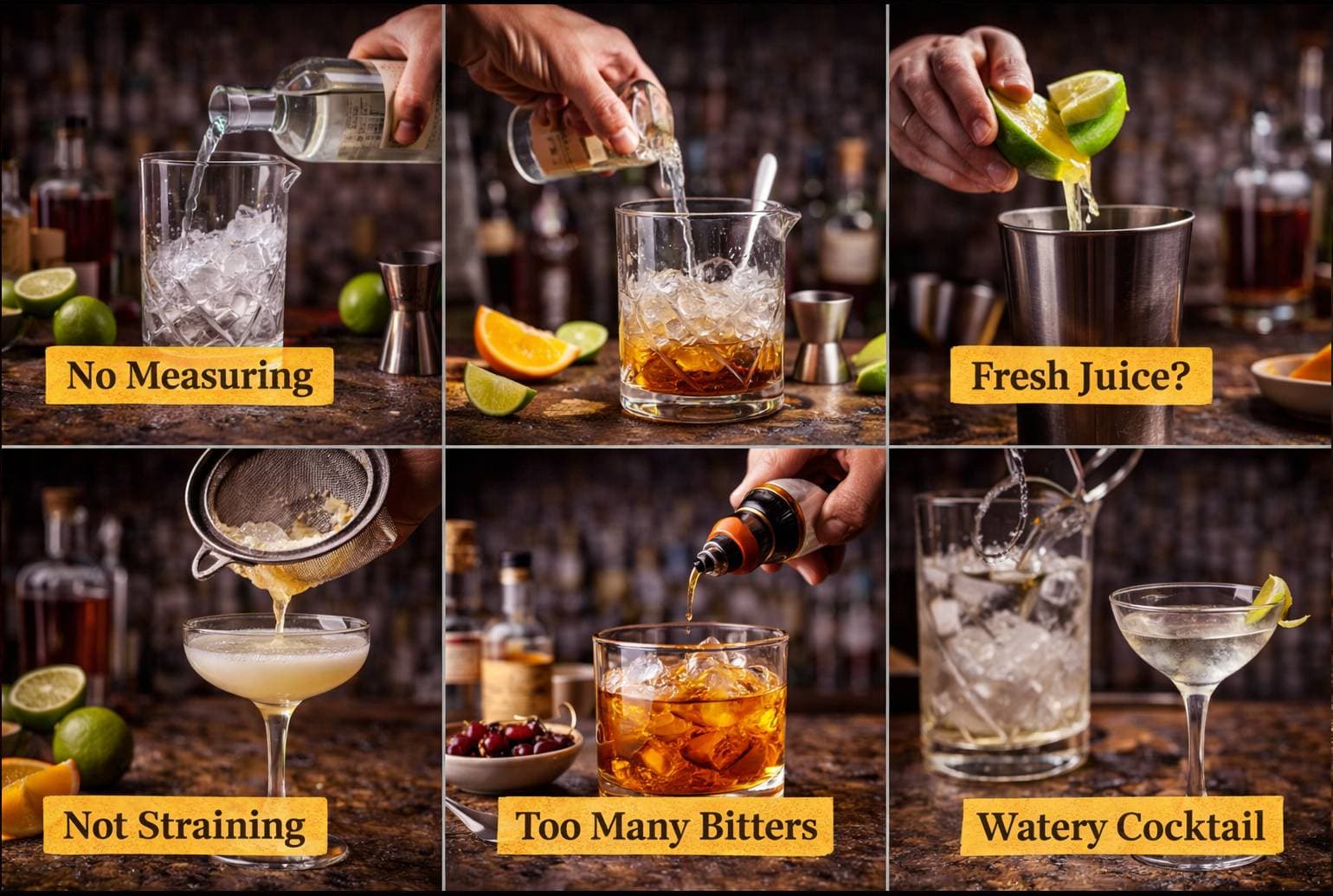
O salto de "consigo seguir uma receita" para "consigo fazer um bom coquetel consistentemente" geralmente é feito corrigindo um punhado de pequenos erros que se acumulam. A maioria dos iniciantes comete os mesmos erros. Aqui estão os cinco mais importantes e exatamente como corrigi-los.
1. Usar Suco de Lima Engarrafado Ao Invés de Fresco
Esta é a maior diferença entre um coquetel sem vida e monótono e um que realmente tem bom sabor.
O suco de lima engarrafado (como Rose's) é um produto conservado projetado para estabilidade de prateleira, não para sabor. Contém açúcar adicionado, conservantes e tem um perfil de sabor desconectado da lima real. Um Gimlet feito com suco de lima Rose's e um Gimlet feito com suco de lima espremido na hora têm sabores completamente diferentes.
O suco de lima fresco é brilhante, acentuado e ácido. Oxida rapidamente — os compostos aromáticos que lhe dão caráter começam a evaporar dentro de horas após ser espremido — razão pela qual os bares espremem cítricos diariamente e descartam o que sobra.
A correção: Use suco de lima espremido na hora. Ponto final.
Esprema o que você precisa para a sessão pouco antes de misturar. Uma lima rende cerca de 30ml de suco, suficiente para um ou dois drinks. Se estiver fazendo múltiplos drinks, esprema 5–10 minutos antes de começar a misturar.
A melhoria da qualidade é imediata e dramática. Esta única mudança — mais do que qualquer ajuste de técnica ou upgrade de equipamento — é o que separa coquetéis iniciantes dos bons.
Se alguma vez tiver dúvida se é pedido fresco ou engarrafado, assuma fresco. Receitas que querem suco engarrafado especificarão "cordial de lima Rose's" ou "suco de lima engarrafado". O padrão é sempre fresco.
2. Não Medir — Dosagem Livre Erra em 20–30%
Dosagem livre — estimar quanto você está despejando e calcular no olho — funciona se você já fez milhares de drinks. Se não fez, não funciona.
O problema é que o equilíbrio da receita é preciso. Um Daiquiri é 60ml de rum, 30ml de suco de lima fresco e 22ml de xarope simples. Se você dosar o rum livre e conseguir 70ml ao invés de 60ml, o drink inteiro agora está 15% mais forte e menos equilibrado. Se estimar o suco de lima e conseguir 22ml ao invés de 30ml, o drink agora está menos azedo e tem sabor monótono.
Estes pequenos erros parecem menores ao fazer um drink. Quando você faz 10 drinks usando a mesma técnica "no olho", metade deles tem sabor estranho.
A correção: Use um dosador.
Um dosador é um copo medidor de dupla face — geralmente com uma medida maior de um lado (frequentemente 45ml) e uma medida menor do outro (frequentemente 22ml ou 30ml). Alguns dosadores têm marcações adicionais (15ml, 7ml).
Meça cada ingrediente. Isso leva cerca de 5 segundos por drink e garante consistência. Uma vez que tenha feito o mesmo coquetel 20 vezes com um dosador, desenvolverá memória muscular suficiente para ocasionalmente estimar. Até então, não faça.
Um bom dosador custa R$50–100 e é a melhor ferramenta que pode comprar. Veja nossa página de ferramentas de bar para recomendações específicas.
3. Agitar Quando Deveria Mexer (Ou Vice-Versa)
A diferença entre agitar e mexer é fundamental, mas não é intuitiva.
Agitar é violento e produz aeração (pequenas bolhas de ar), emulsificação (transformar ingredientes separados em uma textura uniforme) e aproximadamente 25–30% de diluição. Mexer é suave, preserva a clareza e produz aproximadamente 35% de diluição.
Use agitação para drinks com suco cítrico, creme, clara de ovo ou qualquer ingrediente que se beneficie de aeração e emulsificação. Margaritas, Daiquiris, Whiskey Sours, Pisco Sours, Sours em geral.
Use mexer para drinks focados em destilados com pouco ou nenhum cítrico ou modificadores. Martinis, Negronis, Manhattans, Old Fashioneds. Estes drinks querem ter sabor limpo e suave, não aerado.
Um Daiquiri agitado é brilhante e espumoso — o suco cítrico aera, o drink fica turvo, a textura é sedosa. Um Daiquiri mexido é monótono e unidimensional — sem aeração, sem textura, todas as virtudes de um Daiquiri agitado se perdem.
Conversamente, um Martini mexido é suave e sedoso. Um Martini agitado está super-diluído e aguado (a agitação agressiva rompe cristais de gelo e adiciona água demais).
A correção: Leia a receita. Respeite o que ela pede.
Se diz "agite", use uma coqueteleira e gelo. Agite por 10–15 segundos até o exterior ficar gelado. Se diz "mexe", use um copo misturador e gelo. Mexe suavemente por 30–40 segundos até o copo ficar frio. A diferença aparece imediatamente.
Para mais sobre como isso funciona, veja nosso artigo sobre a ciência da diluição.
4. Usar Pouco Gelo
Isso é contraintuitivo, então as pessoas geralmente erram no início.
Mais gelo = menos diluição, não mais. Aqui está o porquê: O objetivo ao agitar ou mexer é gelificar o drink rapidamente. Se estiver usando pouco gelo, ele não faz contato suficiente com a área de superfície das paredes da coqueteleira. A agitação demora mais. O gelo derrete mais. Você acaba com mais diluição, não menos.
Gelo abundante e denso — empacotado firmemente na coqueteleira — resfria o drink rapidamente. Você pode fazer uma agitação vigorosa por 10–15 segundos e terá um drink frio com a quantidade certa de diluição incorporada na receita.
Gelo esparso significa mais tempo agitando, mais derretimento de gelo, drinks aguados.
A correção: Encha completamente a coqueteleira ou copo misturador com gelo.
Para agitar: Encha a metade inferior da coqueteleira (a lata maior) com gelo até estar cheia e ligeiramente transbordando. Isso é tudo. Coquetelerias funcionam melhor quando estão completamente cheias.
Para mexer: Encha o copo misturador até o topo com gelo.
A sensação física é importante — quando o gelo está densamente empacotado, a coqueteleira parece pesada e cheia. Quando o gelo é esparso, ele chacoalha e se move. Gelo denso é correto.
Isso faz parte do porquê o cálculo importa para festas. Você precisa de 500g de gelo por convidado no mínimo, e essa é a linha de base — não uma quantidade generosa. Veja nosso guia de hospedagem de festas para mais sobre quantidades de gelo.
5. Ignorar a Guarnição
A guarnição não é decoração. Óleos expressos de casca cítrica e compostos aromáticos de ervas frescas literalmente mudam o sabor e aroma do drink.
Quando você leva um drink ao nariz, a primeira coisa que cheira são os óleos expressos na superfície e o aroma das ervas frescas. Seu cérebro registra "cítrico" ou "hortelã" antes da sua boca registrar o sabor. Este aroma literalmente muda como seu cérebro percebe o sabor que segue.
Um Old Fashioned sem casca de laranja expressa é um drink diferente de um com ela. Os óleos de laranja mudam toda a experiência. Um Mojito sem hortelã fresca é apenas rum e suco de lima. Um Mojito com hortelã fresca é rum, suco de lima e hortelã.
A correção: Faça a guarnição corretamente.
Para twists cítricos: Corte uma moeda de casca cítrica (cerca do tamanho de uma moeda), segure com o lado colorido para baixo sobre o drink cerca de 5cm de distância, e aperte firmemente para que uma névoa fina de óleo essencial borrife pela superfície. Então deixe cair a casca no drink ou coloque na borda.
Para ramos de ervas: Pegue um pequeno ramo de erva fresca (hortelã, manjericão, tomilho), segure entre suas palmas e bata uma vez para quebrar as células da planta e liberar os óleos. Então deixe cair no drink ou coloque na borda. A batida faz diferença.
A guarnição não é opcional. É parte da receita. Para mais sobre como executar guarnições corretamente, incluindo rodelas cítricas, fatias desidratadas e palitos de coquetel, veja nosso guia detalhado de guarnições.
As Correções Rápidas
| Erro | Correção |
|---|---|
| Suco cítrico engarrafado | Use lima, limão e outros cítricos espremidos na hora |
| Dosagem livre | Meça tudo com um dosador |
| Agitar quando deve mexer (ou vice-versa) | Leia a receita e siga suas instruções exatamente |
| Pouco gelo | Encha completamente a coqueteleira ou copo misturador com gelo |
| Sem guarnição, ou execução pobre de guarnição | Faça a guarnição corretamente — óleos expressos e ervas batidas mudam o drink |
Para Onde Ir Daqui
Estes cinco erros representam 80% do porquê coquetéis iniciantes têm sabor monótono ou estranho. Corrija estes e seus drinks imediatamente terão sabor visivelmente melhor.
Dali, o próximo nível é entender por que uma receita é equilibrada do jeito que é. É onde artigos sobre diluição, cítricos, e como ler uma receita entram.
Mas comece com estes cinco. A melhoria é substancial e imediata.
Pronto para praticar? Navegue nossa coleção de receitas — toda receita inclui instruções claras sobre medição, técnica e guarnição.