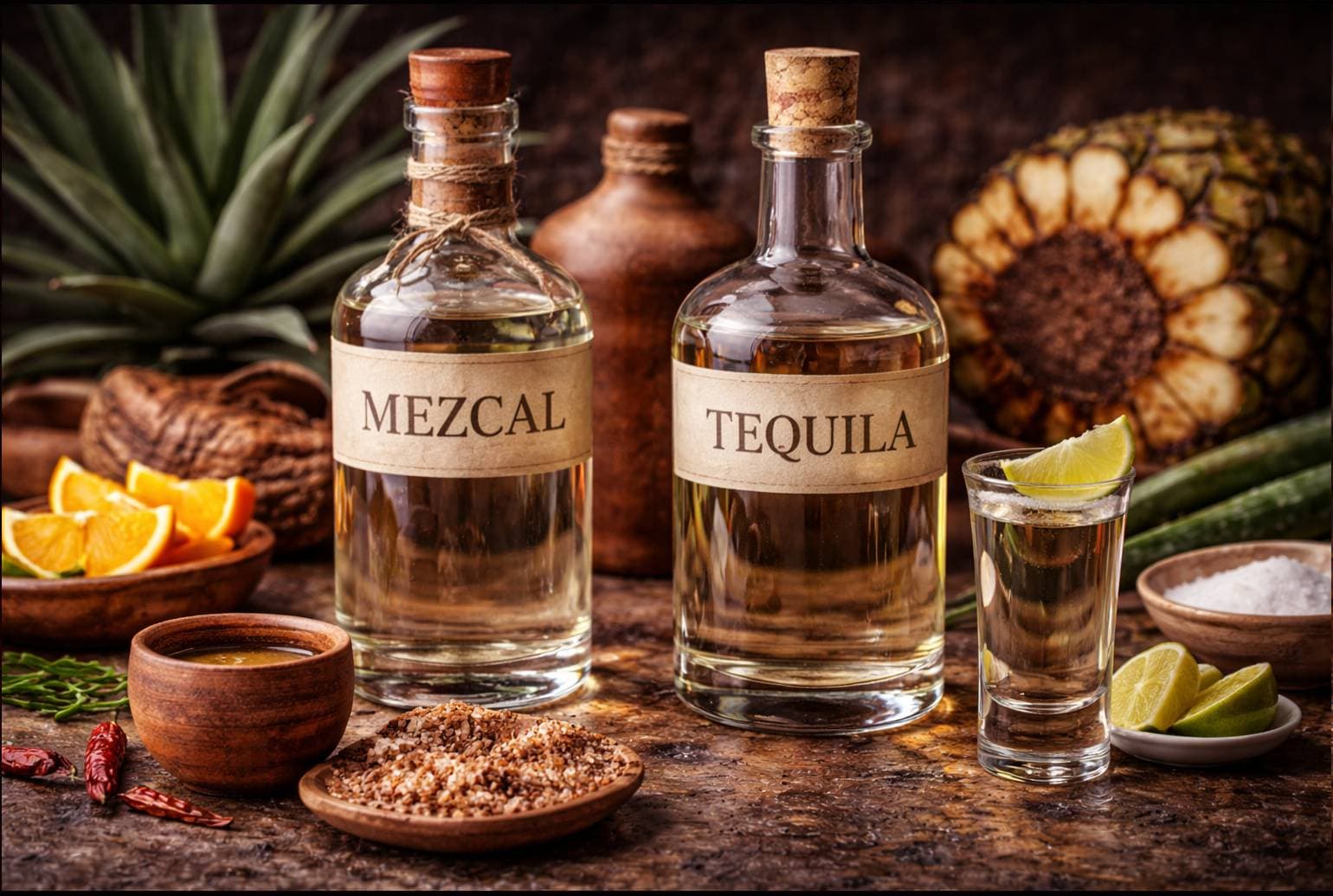
Most people think mezcal is just tequila with a worm—it's not. They're related but made from different agave varieties using different methods. Understanding the distinction opens up a whole category of cocktails you might not otherwise make.
The Relationship: All Tequila Is Mezcal, But Not All Mezcal Is Tequila
This is the fundamental distinction. Mezcal is the umbrella category — any spirit made from agave. Tequila is a specific type of mezcal made in a specific region (Jalisco) from a specific agave variety (blue agave) using specific methods.
By Mexican law, tequila must be:
- Made from at least 51% blue agave (the rest can be other sugars)
- Produced in Jalisco or a few other designated regions
- Distilled to a specific proof range
- Aged or unaged according to the blanco/reposado/añejo classification
Mezcal has fewer restrictions. It can be made from dozens of agave varieties — espadín, tobaziche, madrecuishe, tobalá, and many others (some rare, some cultivated, some wild). It can be made anywhere in the mezcal-producing regions of Mexico, primarily Oaxaca. And the production methods are more varied.
Think of it this way: all tequila is mezcal, but tequila is a highly controlled, regulated subset. Mezcal is the broader category that includes mezcals of all kinds.
Agave Varieties
This is where mezcal gets interesting.
Blue agave is the only agave used in tequila. It's the most cultivated agave variety, widely available, and produces a consistent, predictable spirit. Blue agave grows in farms across Jalisco and nearby regions.
Espadín agave is the most common mezcal agave. It's cultivated, relatively abundant, and produces a clean, herbaceous spirit. Most affordable mezcals use espadín.
Wild and semi-wild agaves like tobaziche, tobalá, and others are rarer and more sought-after. These agaves are foraged or semi-cultivated, their yield is lower, and their flavor is more complex — sometimes with mushroom, mineral, or unique herbal notes. Mezcals made from these varieties are significantly more expensive and are often made in very small batches by artisanal producers.
The variety matters to the flavor. Blue agave mezcal (if such a thing exists — it's rare) would taste similar to tequila. Espadín mezcal tastes different: earthier, more herbaceous, slightly drier. Wild-agave mezcals taste entirely their own way: complex, minerally, sometimes with strange fruity or mushroom notes that make you wonder what you're actually drinking.
The Production Difference: The Smoke Factor
This is the most obvious distinction to your palate.
Tequila is typically produced using industrial methods. The agave hearts (piñas) are cooked in large autoclaves (pressure cookers) or brick ovens for predictable, consistent flavor. Some tequila producers use traditional methods, but efficiency is usually the priority.
Mezcal, especially artisanal mezcal, is made using traditional pit-roasting. The agave piñas are:
- Collected and cut
- Placed in large underground pits lined with stone
- Covered with clay, wood, and dirt
- Roasted for days while smoke surrounds the agave
- Dug up and crushed
The smoke from the burning wood penetrates the agave during this roasting process. This smoke is the defining characteristic of most mezcal — a deep, complex, almost BBQ-like quality that you can taste immediately. It's not a faint hint; it's central to the spirit's identity.
Some industrial mezcal is made with faster, more efficient cooking methods that reduce or eliminate the smoke. These spirits are more tequila-like: cleaner, less distinctive, more approachable. But traditional mezcal is unmistakably smoky.
Industrial vs. artisanal is a spectrum, not a binary. Some producers balance tradition with efficiency. Others commit fully to pit-roasting no matter how long it takes. The age and region of the producer usually tells you which way they lean.
Flavor Profile
Tequila tastes clean, bright, and relatively predictable. Blue agave produces notes of peppery sweetness, sometimes citrus, sometimes herbaceous undertones. Depending on whether it's blanco, reposado, or añejo, you get added notes from barrel aging.
Mezcal tastes smoky, complex, and unpredictable. The smoke is the obvious character, but underneath is agave flavor that varies wildly depending on the variety used. Espadín-based mezcals can taste earthy and herbaceous. Wild-agave mezcals can taste like minerals, earth, fruit, or things without obvious names. The flavor is more challenging, more interesting, and less approachable than tequila for many people.
Mezcal ABV is typically 42–55%, slightly higher than the 40% standard for many spirits. This higher alcohol content contributes to the heat and intensity on the palate.
Which Cocktails Use Mezcal
Mezcal Margarita: This is the obvious starting point. A mezcal Margarita is the same formula as a tequila Margarita — mezcal, lime, triple sec — but the smoke from the mezcal transforms the drink. It becomes more complex, earthier, less fruity-bright. Some people love it. Some prefer the clean brightness of tequila. Try both.
Mezcal Negroni: Negroni with mezcal instead of gin is an inspired swap. The smoke from the mezcal plays beautifully against Campari's bitterness and sweet vermouth's richness. This is where mezcal genuinely shines — in stirred, spirit-forward drinks where the complex smoke character is the point.
Oaxaca Old Fashioned: This is a classic mezcal cocktail — mezcal (usually blanco) with a small amount of dark mezcal for smoke, bitters, sugar, orange peel. It's a template that shows off mezcal's character without overwhelming it. The smoke is present but balanced by the sweetness of the sugar and the warmth of the bitters.
Smoke-washed cocktails: Some bartenders take smoke-washing a step further by mixing mezcal into cocktails specifically for its smoke contribution. A Margarita with a small float of Dos Hombres mezcal, or a Daiquiri with a tiny amount of pechuga mezcal. The mezcal adds smoke and complexity without overpowering the drink.
Mezcal Sour (mezcal, lime, simple syrup, egg white): This is a less common mezcal cocktail than the Margarita, but it's excellent. The egg white adds silkiness that pairs well with mezcal's intensity. The citrus balances the smoke.
Mezcal in Tiki: Some Tiki enthusiasts use mezcal in Tiki drinks for the smoke element. A Mai Tai made with mezcal instead of (or in addition to) rum becomes more complex and smoky. This is experimentation territory — traditional Tiki doesn't use mezcal, but the category is adventurous by nature.
The Batch Cocktail Question
Can you make frozen batch cocktails with mezcal? Yes, technically. Mezcal's higher ABV (typically 42–55%) means you need to adjust your batch alcohol calculations carefully. Frozen drinks need to land in the 5–10% ABV range to freeze properly in a machine. Since mezcal is higher-proof than standard 40% spirits, it will push your batch closer to (or over) that limit.
Should you? Mezcal's defining characteristic — the smoke — can get strange when ice-cold. The smoke becomes harsh, metallic, almost unpleasant. Smoked cocktails are better served room temperature or over ice as single drinks, not frozen in a batch. That said, if you're making frozen Margaritas and you want a smoky version, you could use a small amount of mezcal mixed with blanco tequila. The smoke would be present but not overwhelming.
For batch calculations with mezcal, see our guide on batch cocktail math and adjust for the higher ABV.
What to Buy
If you're buying one mezcal: Start with an espadín-based mezcal in the $40–60 range. It's approachable, the smoke is clear, and you can taste what mezcal is about. Brands like Del Maguey Vida or Mezcal Vago are excellent entry points.
If you want to experiment: Buy a bottle of blanco mezcal and make a Mezcal Margarita side-by-side with a tequila Margarita. The difference is immediate and educational.
If you want to go deeper: Try a wild-agave mezcal (more expensive, $60–100+). These are where mezcal gets truly interesting. The flavor is complex, strange, and utterly different from tequila. But they're also more acquired and less versatile in cocktails.
The proof question: Mezcal's higher ABV means it contributes more alcohol per ounce than standard spirits. A 1 oz pour of mezcal at 45% ABV is noticeably stronger than the same pour of tequila at 40% ABV. This matters for cocktail balance and especially for batch calculations.
Mezcal vs. Tequila in Cocktails: The Quick Guide
| Cocktail | Tequila or Mezcal? | Why |
|---|---|---|
| Margarita | Either; try both | Tequila is classic; mezcal adds smoke |
| Paloma | Tequila | The clean tequila lets grapefruit shine |
| Negroni | Mezcal | The smoke plays beautifully with Campari |
| Oaxaca Old Fashioned | Mezcal | This drink was designed for mezcal |
| Tequila Sour | Tequila | The citrus and egg white work better with tequila's clarity |
| Frozen/batch drinks | Tequila (blanco) | Mezcal's smoke gets weird when ice-cold |
The Quick Rule
Tequila for classic cocktails, frozen drinks, and when you want clarity and brightness.
Mezcal for sophisticated sipping, stirred cocktails, and when you want smoke and complexity as part of the drink's character.
When you see a mezcal cocktail on a menu, order it. Mezcal is too interesting to ignore, even if it's not your default spirit.
Browse our tequila cocktail recipes to compare with mezcal versions, check out batch recipes where you can adapt classic drinks, or use the Ingredient Matcher to find mezcal cocktails based on what you have at home.