You found a great cocktail recipe. It makes one drink. You need to make 20 for a party. The obvious move is to multiply everything by 20. And that's exactly how you end up with 20 bad drinks.
Scaling cocktails isn't straight multiplication. Dilution, ice melt, carbonation, citrus oxidation, and sugar balance all behave differently at batch scale. Here's the math that actually works.
Why You Can't Just Multiply
A single-serve cocktail recipe accounts for things that happen during preparation — specifically, shaking or stirring with ice. When you shake a Margarita for 10–15 seconds, two things happen: the drink gets cold, and ice melts into the drink, adding roughly 25–30% water by volume. That dilution is part of the recipe. The bartender who designed it assumed it would be there.
When you batch that same recipe by multiplying the ingredients by 20 and pouring them into a pitcher, there's no shaking step and no ice melt. You've got an undiluted concentrate that's significantly stronger, sweeter, and more intense than intended.
This is the most common batch cocktail mistake: the drink tastes "off" and people assume the recipe is bad, when really they're tasting the missing dilution.
The Dilution Factor
For stirred cocktails (Manhattans, Old Fashioneds, Martinis), stirring with ice adds roughly 20–25% water to the drink's total volume.
For shaken cocktails (Margaritas, Daiquiris, Whiskey Sours), shaking adds roughly 25–30% water.
When batching, you need to add this water yourself. The general rule:
For a shaken cocktail batch: Add water equal to 25% of the total batch volume. If your combined ingredients make 100 oz, add 25 oz of water.
For a stirred cocktail batch: Add water equal to 20% of the total batch volume.
For a frozen machine batch: The machine itself provides dilution through the freezing and churning process, but less than shaking would. Our batch recipes already account for this — the ratios are adjusted for machine use, which is why they differ from a straight multiplication of the single-serve version.
Citrus Changes at Scale
Fresh citrus juice is the most volatile ingredient in cocktail batching. It behaves differently in large quantities and over time:
Oxidation. Fresh lime and lemon juice start losing their brightness within 4–6 hours of being squeezed. A single Daiquiri is made and consumed in minutes. A gallon batch might sit for hours before the last glass is poured. The citrus will taste flatter, duller, and less vibrant in the later servings.
The fix: Squeeze citrus as close to batch time as possible. If you're batching for a party, squeeze the citrus last — after you've measured and combined everything else. For frozen machine batches that will run for hours, consider adding 10–15% more citrus than the scaled recipe calls for to compensate for oxidation.
Concentration. In a single drink, a half-ounce of lime juice is balanced by the dilution from shaking. In a batch where you've pre-added the dilution water, the citrus is hitting differently because it's interacting with more total liquid. Taste and adjust — you may want slightly more or slightly less citrus than pure math suggests.
Sweetener Scaling
Sweeteners scale more predictably than citrus, but there's a nuance: the relationship between sugar and perceived sweetness isn't perfectly linear in large volumes.
In practice, most batchers find they need slightly less sweetener than straight multiplication suggests — roughly 85–90% of the calculated amount. A recipe calling for ¾ oz simple syrup per drink doesn't necessarily need 15 oz in a 20-drink batch. Start with 13 oz, taste, and add more if needed.
For frozen machine batches, sweetener has an additional role: it controls Brix, which determines whether the batch freezes properly. The target is 13–18 Brix. If you reduce sweetener for taste, you may drop below the freezing threshold. This is where a refractometer is essential — it tells you whether your sugar reduction went too far for the machine even if it tastes right to you.
For more on Brix and frozen drink machines, see: What Is Brix and How to Check It.
Carbonation Doesn't Batch
Carbonated ingredients — soda water, tonic, ginger beer, prosecco, champagne — cannot be added to a batch in advance. The carbonation dissipates within minutes in an open container and even faster in a frozen drink machine (the churning action destroys bubbles).
The rule: Batch everything except carbonated ingredients. Add sparkling components per glass at serving time.
For a batch of 20 Gin & Tonics: batch the gin and any citrus/sweetener components. Pour the appropriate portion into each glass over ice, then top with tonic water from a freshly opened bottle.
For a batch of Aperol Spritzes: batch the Aperol. Pour individual servings over ice, then add prosecco and a splash of soda to each glass.
Our batch recipe model marks carbonated ingredients as "not batch scalable" for exactly this reason — they're listed with a note to add per glass when serving.
ABV at Scale
Alcohol content matters more in batch cocktails than most people realize, especially for frozen machines.
In a single drink, you might not think about the exact ABV — you just know a Margarita has tequila in it. But in a batch, the total ABV determines whether the batch will freeze in a machine. The target for frozen batches is 5–10% ABV in the final mixed volume (including dilution water).
To estimate ABV for your batch:
- For each spirit, multiply its volume by its ABV (e.g., 20 oz of 40% tequila = 8 oz of pure alcohol)
- For each liqueur, do the same (e.g., 10 oz of 20% triple sec = 2 oz of pure alcohol)
- Add up all the pure alcohol: 8 + 2 = 10 oz
- Divide by total batch volume (including water and all other ingredients)
- If total volume is 128 oz (1 gallon): 10 / 128 = 7.8% ABV
MixologyRecipe calculates this automatically on our batch recipe pages, but knowing the math helps when you're adapting your own recipes.
The Batch Math Cheat Sheet
Here's a step-by-step process for scaling any single-serve recipe to a batch:
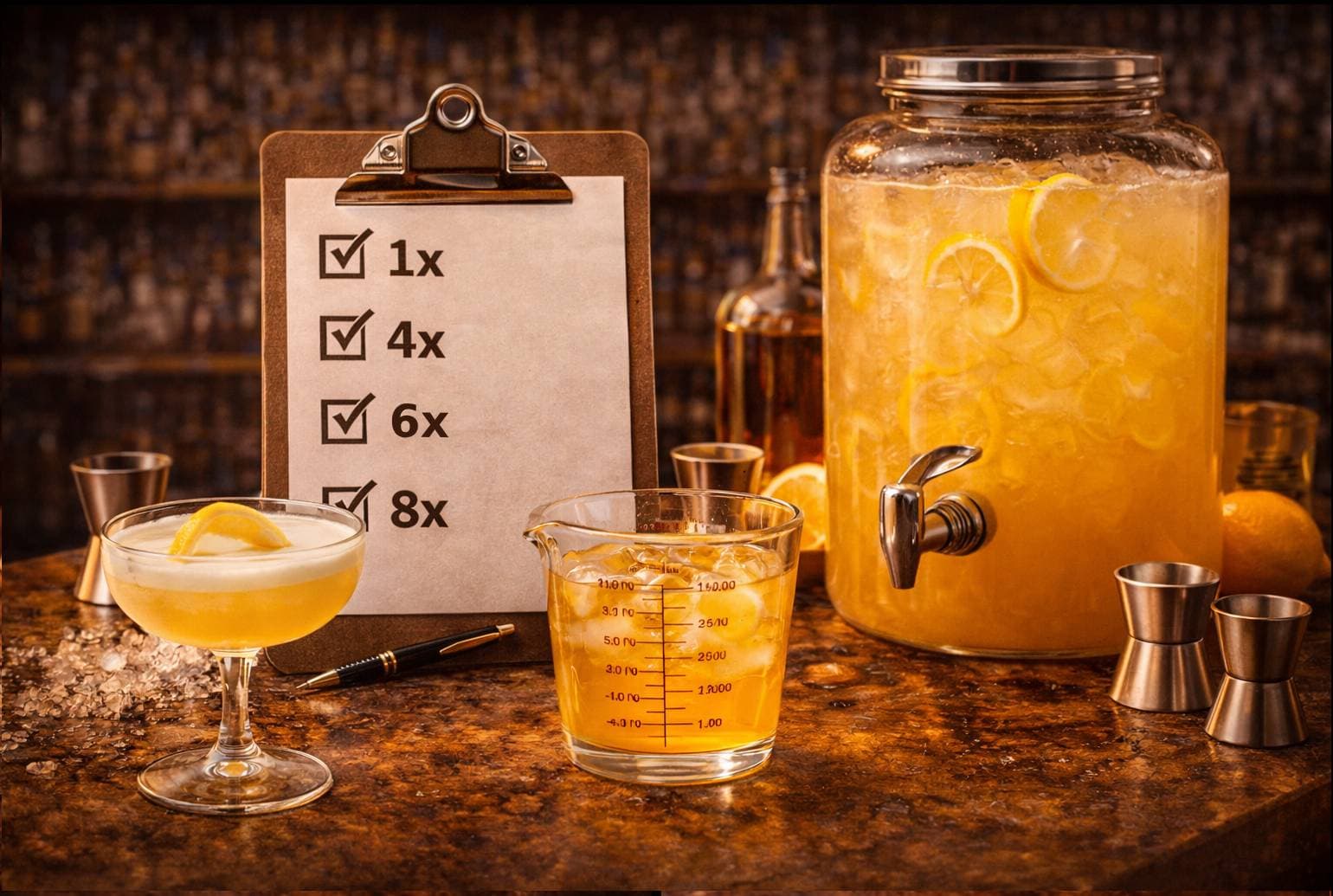
Step 1: Decide your batch size. Our recipes use 1 gallon (128 oz) as the standard. Figure out how many single servings you want and work backward.
Step 2: Multiply all non-carbonated ingredients by your batch factor. If the recipe makes a 6 oz drink and you want 128 oz, multiply by roughly 21.
Step 3: Add dilution water. Add 25% extra volume for shaken recipes, 20% for stirred. For frozen machine batches, add 15% (the machine provides some dilution).
Step 4: Reduce sweetener slightly. Start with 85–90% of the calculated sweetener amount. You can always add more.
Step 5: Increase citrus slightly. Add 10–15% more citrus than calculated, especially if the batch will sit for more than an hour.
Step 6: Check Brix (for frozen batches). Use a refractometer to verify you're in the 13–18 range. Adjust with simple syrup (to raise) or water (to lower).
Step 7: Check ABV (for frozen batches). Calculate or use MixologyRecipe's automatic estimate. Target 5–10% for the final batch.
Step 8: Taste and adjust. The math gets you close. Your palate gets you the rest of the way.
Step 9: Chill before pouring. Pre-chill your batch in the refrigerator before adding it to a frozen machine. Pouring room-temperature liquid into a machine makes it work harder and takes longer to reach frozen consistency.
Why Our Batch Recipes Are Different
This is exactly why MixologyRecipe's batch recipes are built as a separate collection rather than a "multiply by 20" button on single-serve recipes. Each batch recipe has been adjusted for dilution, citrus balance, sweetener ratios, and — for frozen recipes — Brix and ABV targets. The ratios are different from the single-serve version because they need to be.
A frozen batch Margarita might have more simple syrup and less lime juice than you'd expect from scaling up the classic recipe. That's intentional — it's formulated to hit the right Brix for your machine while still tasting balanced.
Looking for batch recipes that have already done the math? Browse our batch cocktail recipes for tested 1-gallon recipes with Brix and ABV estimates built in.