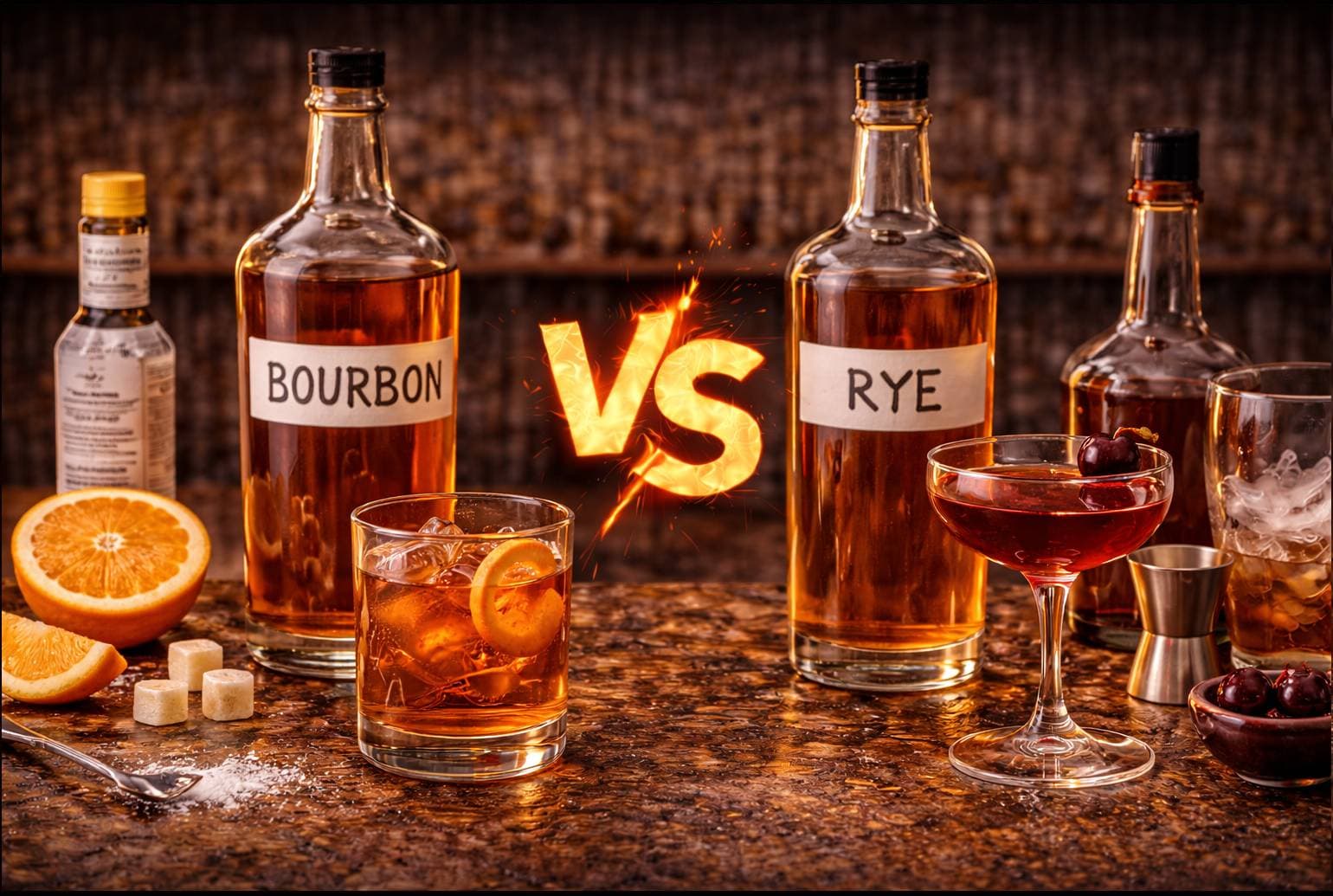
Bourbon and rye are both American whiskeys — both brown, both 80–100 proof, both in the same cocktails. Many recipes just say "whiskey" and leave you guessing. But they taste meaningfully different, and that difference changes how a cocktail lands.
The Legal Difference
Both bourbon and rye are defined by U.S. law, and the definitions come down to what grain makes up the majority of the mash bill — the recipe of grains that gets fermented and distilled.
Bourbon must be made from at least 51% corn. The rest is typically a mix of malted barley and either rye or wheat. It must be aged in new charred oak barrels, distilled to no more than 160 proof, and entered into the barrel at no more than 125 proof. There's no minimum aging requirement unless it's labeled "straight bourbon" (which requires at least 2 years).
Rye whiskey must be made from at least 51% rye grain. Same barrel requirements, same proof limits, same aging rules as bourbon. The difference is the dominant grain.
That 51% threshold is the floor, not the ceiling. Many bourbons are 70–80% corn. Many ryes are 80–95% rye. The higher the percentage of the defining grain, the more pronounced its flavor characteristics.
The Flavor Difference
This is what actually matters for cocktails.
Bourbon tastes sweeter, rounder, and softer. The high corn content produces caramel, vanilla, and baking spice flavors. The new charred oak adds toffee and brown sugar. A sip of bourbon feels warm and enveloping — there's a natural sweetness that doesn't come from added sugar. It's approachable.
Rye tastes spicier, drier, and more assertive. Rye grain produces black pepper, clove, cinnamon, and herbal flavors. Where bourbon rounds off, rye pushes forward. A sip of rye has a peppery bite on the finish that bourbon doesn't. It's more angular.
Think of it this way: bourbon is the warm handshake, rye is the firm one.
When It Matters in Cocktails
Old Fashioned: This is where the difference is most noticeable. A bourbon Old Fashioned is sweeter, mellower, and more dessert-like. A rye Old Fashioned is drier, spicier, and more complex. Neither is wrong — they're different drinks. Most bars default to bourbon because it's more crowd-pleasing, but the classic recipe was originally made with rye.
Manhattan: Historically a rye cocktail. The spice of rye plays against the sweetness of the vermouth, creating a balanced tug-of-war. Bourbon Manhattans are sweeter and rounder — pleasant, but they can tip into cloying territory if the vermouth is already sweet. If you find your Manhattans taste a little one-note, try switching to rye.
Whiskey Sour: The citrus and sweetener in a Whiskey Sour mask a lot of the bourbon-vs-rye difference. Either works well. Bourbon makes a softer, more approachable sour. Rye makes one with more backbone and a drier finish.
Mint Julep: Bourbon. Always bourbon. The sweetness of the bourbon, the sugar, and the mint are a classic combination. Rye in a Julep would be too dry and aggressive for the drink's intended character.
Sazerac: Rye. This is a New Orleans classic that depends on rye's spice to stand up to the absinthe rinse and Peychaud's bitters. Bourbon makes the drink too sweet and muddled.
Boulevardier: Either works, but they produce noticeably different drinks. Bourbon makes it sweeter and more approachable (closer to a dessert cocktail). Rye makes it more bitter and herbal (closer to a Negroni in spirit). Try both and see which you prefer.
When It Doesn't Matter
In cocktails with a lot going on — Tiki drinks that call for whiskey, complex multi-spirit cocktails, or highballs where the mixer dominates — the bourbon-rye distinction gets buried. A Whiskey Ginger tastes roughly the same with either. A John Collins with bourbon vs. rye is a subtle difference at best. Save the deliberate choosing for drinks where the whiskey is the star.
What to Buy
If you're buying one bottle: Bourbon is the safer starter. It's more versatile, more crowd-pleasing, and works in every whiskey cocktail even if it's not the "traditional" choice. A mid-shelf bourbon in the $25–35 range (like Buffalo Trace, Evan Williams Single Barrel, or Wild Turkey 101) covers everything from Old Fashioneds to Whiskey Sours.
If you're buying two bottles: Add a rye. Rittenhouse Rye (bonded, 100 proof) is the bartender's go-to — it has enough spice to stand up in a Manhattan or Sazerac and enough body to work in a sour. It's usually under $30.
The proof question: Higher-proof whiskeys (100 proof / 50% ABV) hold their flavor better in cocktails because the dilution from ice or shaking doesn't wash them out. An 80-proof bourbon in an Old Fashioned can taste thin after the ice melts for a few minutes. A 100-proof bourbon keeps its character longer. This applies equally to rye.
For batch cocktails in frozen drink machines, remember that both bourbon and rye are typically 40–50% ABV, which means they contribute significantly to the batch's total alcohol content. Keep your final batch ABV in the 5–10% range for proper freezing. See our guide on Proof vs. ABV vs. v/v for the conversion math.
The Quick Rule
Bourbon when you want the cocktail to lean sweet, warm, and approachable. Rye when you want it to lean dry, spicy, and complex.
When in doubt, try the drink both ways. That's the whole point of having a home bar.
Browse our whiskey cocktail recipes or use the Ingredient Matcher to find drinks based on what's already on your shelf.