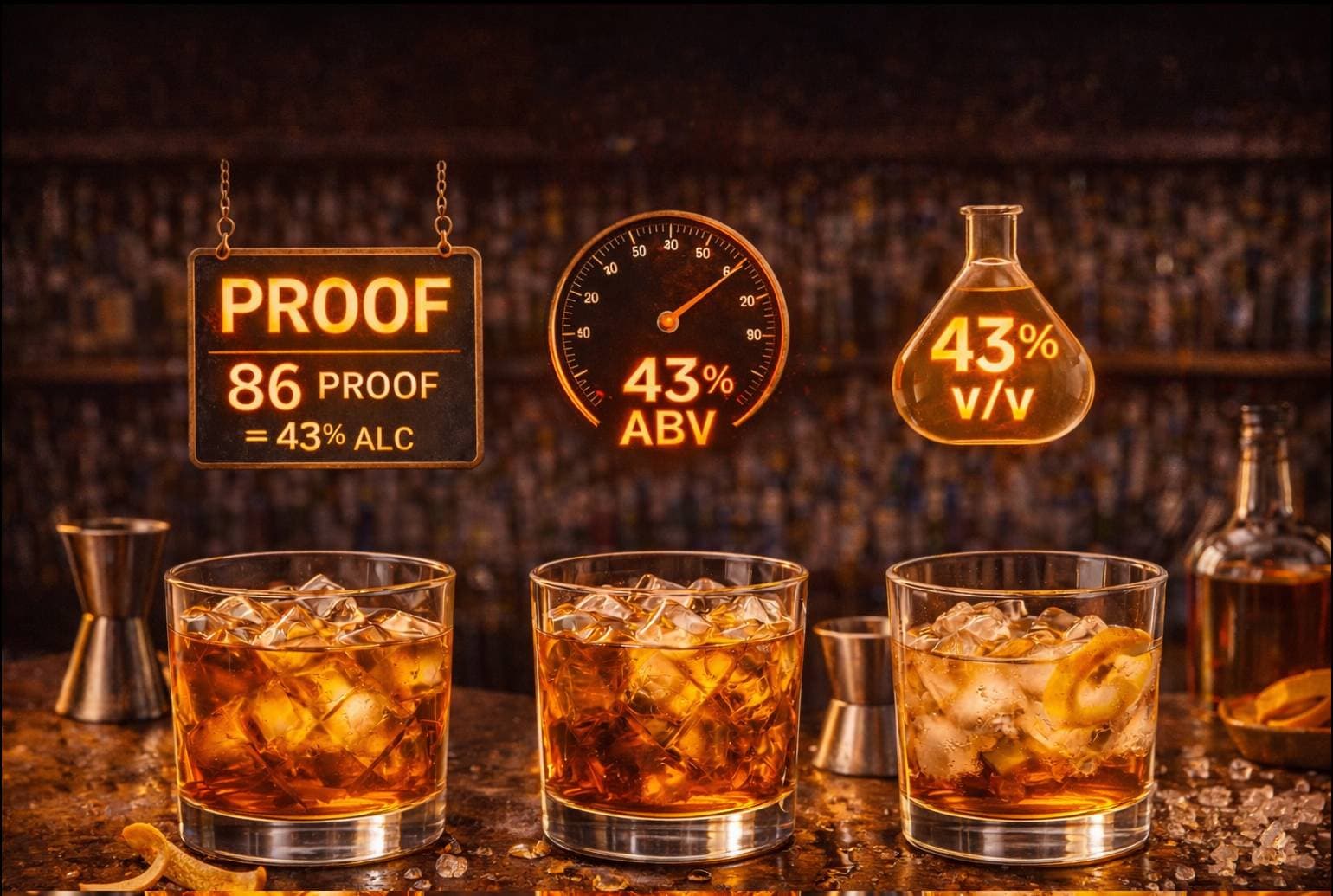
Sie werden die Alkoholkonzentration je nach Quelle auf drei verschiedene Arten ausgedrückt sehen: Proof auf amerikanischen Flaschenetiketten, ABV auf den meisten modernen Verpackungen und v/v auf Refraktometerskalen und wissenschaftlichen Referenzen.
Sie alle messen dasselbe — wie viel der Flüssigkeit Ethanol ist — aber die Zahlen sind unterschiedlich, was für Verwirrung sorgt.
Hier ist die schnelle Umrechnung und wann jede einzelne wichtig ist.
ABV (Alcohol by Volume / Alkohol nach Volumen)
ABV ist der globale Standard. Er drückt den Prozentsatz des Gesamtvolumens einer Flüssigkeit aus, der reines Ethanol ist. Eine mit 40% ABV etikettierte Flasche bedeutet, dass 40% der Flüssigkeit darin Ethanol ist und die verbleibenden 60% Wasser und andere Verbindungen sind.
ABV ist das, was Sie auf praktisch jeder weltweit verkauften Flasche sehen werden. Es ist auch das, worauf sich Cocktailrezepte beziehen, wenn sie über die Stärke einer Spirituose sprechen. Wenn wir sagen, ein Cocktail hat 40% ABV, meinen wir, dass 10% des Volumens des fertigen Getränks reiner Alkohol ist.
Wo Sie es sehen werden: Flaschenetiketten (nahezu universell), Cocktailrezepte, unsere Batch-Rezept ABV-Schätzungen.
Proof (U.S.)
Proof ist ein älteres System, das hauptsächlich eine amerikanische Konvention ist. In den USA ist Proof einfach ABV multipliziert mit 2. Das ist die gesamte Umrechnung:
- 80 Proof = 40% ABV
- 100 Proof = 50% ABV
- 151 Proof = 75,5% ABV
Es gibt keine komplizierte Mathematik. Teilen Sie die Proof-Zahl durch 2 und Sie haben ABV.
Das Proof-System stammt aus einer Zeit, in der die Alkoholstärke buchstäblich "bewiesen" wurde, indem man sie mit Schießpulver mischte und anzündete. Wenn das Schießpulver noch zündete, war die Spirituose mindestens 50% Alkohol — oder "100 Proof". Alles unter dieser Schwelle war "under proof". Die mathematische Definition (Proof = 2 × ABV) wurde später standardisiert, aber die Terminologie blieb.
Wo Sie es sehen werden: U.S. Flaschenetiketten (neben ABV), amerikanische Spirituosenladen-Beschilderung, ältere Cocktailbücher.
Wichtiger Hinweis: Das britische Proof-System unterscheidet sich vom amerikanischen und verwendet einen anderen Multiplikator (etwa 1,75 statt 2). Britisches Proof wird heute selten verwendet — praktisch alle moderne Etikettierung verwendet ABV — aber wenn Sie ein altes Cocktailbuch aus Großbritannien lesen, beachten Sie, dass "100° Proof" britisch etwa 57% ABV bedeutet, nicht 50%.
v/v (Volume by Volume / Volumen nach Volumen)
v/v steht für "Volumen nach Volumen" und ist funktional identisch mit ABV — beide drücken den Prozentsatz des Volumens einer Flüssigkeit aus, der Ethanol ist. Die Bezeichnung "40% v/v" bedeutet dasselbe wie "40% ABV".
Der Unterschied liegt im Kontext. ABV ist der verbraucherorientierte Begriff auf Flaschenetiketten. v/v ist die technische und wissenschaftliche Bezeichnung, die in Laborumgebungen, auf Refraktometerskalen und in regulatorischen Dokumenten verwendet wird.
Wo Sie es sehen werden: Alkohol-Refraktometer Skalen (0–80% v/v), wissenschaftliche Literatur, technische Brau- und Destillationsreferenzen, unsere Refraktometer-Anleitungen.
Wenn Sie ein Alkohol-Refraktometer ablesen und es "40% v/v" zeigt, ist das dasselbe wie zu sagen, die Flüssigkeit ist 40% ABV oder 80 Proof.
Die Umrechnungstabelle
| Proof (U.S.) | ABV (%) | v/v (%) | Häufiges Beispiel |
|---|---|---|---|
| 0 | 0 | 0 | Wasser, Saft, Limonade |
| 22 | 11 | 11 | Aperol |
| 30 | 15 | 15 | Süßer Wermut |
| 40 | 20 | 20 | Kahlúa, Triple Sec |
| 50 | 25 | 25 | Campari |
| 60 | 30 | 30 | Einige Liköre |
| 70 | 35 | 35 | — |
| 80 | 40 | 40 | Die meisten Wodka, Gin, Rum, Tequila |
| 86 | 43 | 43 | Viele Scotch Whiskys |
| 90 | 45 | 45 | Viele Bourbons |
| 100 | 50 | 50 | Bonded Spirituosen |
| 114 | 57 | 57 | Fassstärke Bourbon (üblicher Bereich) |
| 120 | 60 | 60 | Navy-Strength Gin |
| 151 | 75,5 | 75,5 | Bacardi 151, Lemon Hart 151 |
| 190 | 95 | 95 | Everclear (wo legal) |
Warum das für Batch-Cocktails wichtig ist
Wenn Sie ein einzelnes Getränk zubereiten, müssen Sie normalerweise nicht über Alkohol-Mathematik nachdenken — Sie gießen 60 ml Bourbon ein und das war's. Aber für Batch-Cocktails, besonders für Frozen-Drink-Maschinen, ermöglicht es Ihnen, den ABV jeder Zutat zu kennen, den Gesamtalkoholgehalt des Batches zu berechnen.
Frozen-Drink-Maschinen sollten eine finale gemischte Charge nahe 5–10% ABV haben, um richtig zu gefrieren. Über 10% verhindert der Alkohol, dass die Mischung rechtzeitig die richtige gefrorene Textur erreicht. Zu wissen, dass Ihr Tequila 40% ABV (80 Proof) und Ihr Triple Sec 20% ABV (40 Proof) hat, lässt Sie berechnen, ob Ihr Batch mit der Maschine zusammenarbeiten wird. Deshalb ist es so wichtig, Ihren Batch vor dem Eingießen in die Frozen-Drink-Maschine vorzukühlen.
Ein schnelles Beispiel: Wenn Ihr 3,8-Liter (128 oz) Batch 480 ml (16 oz) 40% ABV Tequila und 240 ml (8 oz) 20% ABV Triple Sec enthält, ist der Gesamtalkohol (16 × 0,40) + (8 × 0,20) = 6,4 + 1,6 = 8 oz reiner Alkohol. Geteilt durch 128 oz Gesamtvolumen sind das 6,25% ABV — genau im Sweet Spot.
MixologyRecipe berechnet das automatisch auf unseren Batch-Rezept-Seiten, aber das Verständnis der Mathematik hilft, wenn Sie Ihre eigenen Rezepte anpassen oder einen Batch troubleshooten, der nicht gefriert.
Die Ein-Satz-Zusammenfassung
Proof ÷ 2 = ABV = v/v. Das ist die ganze Umrechnung. ABV und v/v sind dieselbe Zahl. Proof ist das Doppelte dieser Zahl. Alles andere ist Kontext.
Für mehr über das Messen von Alkoholgehalt mit einem Refraktometer, siehe: Alkohol-Refraktometer vs. Brix-Refraktometer — Welches brauchen Sie?