Aperol and Campari are both Italian bitters, but they differ in bitterness, ABV, and flavor in ways that matter for every cocktail you put them in. Here is how to use each one correctly.
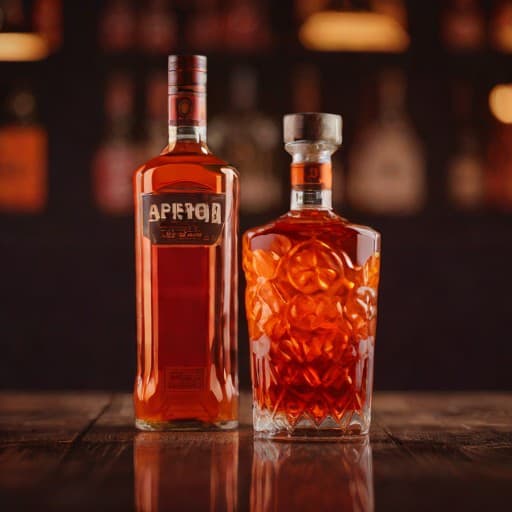
Aperol and Campari sit next to each other on every liquor store shelf, both in their distinctive bottles — Aperol in bright orange, Campari in deep red. They are both Italian aperitivo bitters. They are both used in Spritzes. They both end up in Negroni conversations. And at some point, every home bartender looks at the two bottles and wonders: are these basically the same thing?
They are not. The differences between Aperol and Campari are significant — in bitterness, in alcohol content, in flavor profile, and in how they function in cocktails. Swapping one for the other is not a neutral substitution. Sometimes it works. Sometimes it wrecks the drink. Understanding why requires knowing what each one actually brings to the glass.
The Basics: What They Are
Both Aperol and Campari are Italian bitter liqueurs (also called aperitivi) — spirits infused with a proprietary blend of herbs, spices, roots, and citrus peels (for more on the role of bitters in cocktails, see our primer). Both are made by the Campari Group (Davide Campari-Milano), which owns both brands. Both are designed to be drunk before a meal as appetite stimulants — that is what "aperitivo" means.
Campari was created in 1860 by Gaspare Campari in Novara, Italy, and later became associated with Milan's cafe culture. It has been produced continuously for over 160 years. Campari's exact recipe is a closely guarded secret, but it is known to contain a blend of herbs, aromatic plants, and fruit infused in a combination of alcohol and water. The iconic red color was originally derived from carmine dye (made from cochineal insects); since 2006, Campari has used artificial coloring instead.
Aperol was created in 1919 by the Barbieri brothers in Padua, Italy, and was acquired by the Campari Group in 2003. Aperol's recipe includes gentian, rhubarb, cinchona, and a blend of herbs and roots. Its bright orange color is its visual signature. Aperol was a regional Italian product for decades before the Aperol Spritz marketing campaign of the 2000s turned it into a global phenomenon.
Both are widely available worldwide, and both are affordable — typically $22-28 for a 750ml bottle. Both keep essentially indefinitely once opened, no refrigeration required.
The ABV Difference: This Matters More Than You Think
Here is the first major distinction, and it has practical consequences for every drink you make.
Campari is bottled at 24% ABV (48 proof) -- if the relationship between proof, ABV, and % v/v is fuzzy, we have a guide for that. In some markets it was historically 25% or even 28.5%, but the current global standard is 24%.
Aperol is bottled at 11% ABV (22 proof). That is less than half the alcohol content of Campari.
This is not a trivial difference. When you pour 1 oz of Campari into a Negroni, you are adding a meaningful amount of alcohol to a stirred, spirit-forward cocktail. When you pour 3 oz of Aperol into a Spritz, you are adding roughly the same amount of alcohol as a light beer. The ABV difference fundamentally changes how these liqueurs interact with other ingredients, how they affect dilution, and how boozy the final drink feels.
In practical terms: drinks made with Aperol are lighter, lower-alcohol, more sessionable. Drinks made with Campari are stronger, more assertive, more serious. This is by design. Aperol was created to be the gentler, more approachable option. Campari was created for people who like their bitter to bite.
When substituting one for the other, you are not just changing the flavor — you are changing the alcohol structure of the entire cocktail. That matters.
The Bitterness Gap
This is the difference most people notice first, and it is not subtle.
Campari is aggressively bitter. It is one of the most bitter spirits commonly used in cocktails. The bitterness is central, persistent, and unapologetic — it arrives immediately, occupies the entire palate, and lingers on the finish. If you have ever tasted Campari neat and involuntarily made a face, you are in good company. It is an acquired taste, and the acquisition takes some people multiple attempts. The bitterness comes from a combination of botanical extracts, with bitter orange peel, cascarilla bark, and chinotto being key contributors.
Aperol is mildly bitter. It has bitterness, but it is gentle, approachable, and balanced by significant sweetness and citrus. A first-time drinker can sip Aperol on the rocks without grimacing. The bitterness registers as a pleasant undertone — like the pleasant bitterness of orange marmalade — rather than a dominant flavor. If Campari's bitterness is a shout, Aperol's is a polite suggestion.
On a rough bitterness scale where water is 0 and pure gentian root extract is 10, Campari sits around a 7 and Aperol around a 3. This is a subjective assessment, but it captures the magnitude of the gap. They are not slightly different in bitterness — they are dramatically different. This is the single most important thing to understand when deciding which to use in a cocktail.
Flavor Profiles: Beyond the Bitterness
Bitterness is only part of the picture. The underlying flavor profiles are distinct in ways that matter for cocktail construction.
Campari tastes bitter, herbal, and slightly medicinal, with notes of grapefruit pith, cherry, orange peel, and a lingering dry finish. There is a rooty, earthy quality underneath the bitterness — something almost bark-like. The sweetness in Campari exists (it contains significant sugar), but it is firmly subordinate to the bitter and herbal elements. Campari has weight on the palate. It lingers. It demands attention and does not fade politely into the background of a cocktail.
Aperol tastes sweet, citrusy, and lightly bitter, with dominant notes of blood orange, rhubarb, and vanilla. There is a pleasant, almost candy-like quality to Aperol that makes it immediately likeable. The herbal elements are present but soft — you get a hint of gentian and a whisper of botanical complexity, but the overall impression is bright, fruity, and refreshing. Aperol is lighter on the palate, and it finishes clean rather than lingering.
Think of it this way: Campari tastes like a cocktail ingredient — intense, concentrated, designed to be part of a larger whole where its bitterness plays against other flavors. Aperol tastes like something you could drink on its own over ice with a splash of soda and be perfectly happy. Both are valid approaches. They just serve fundamentally different purposes in a glass.
The Spritz: Same Template, Different Drinks
The Spritz is where most people first encounter both Aperol and Campari, and it is the clearest demonstration of how different they are in practice.
The Aperol Spritz is the version that conquered the world. The standard recipe:
- 3 oz Aperol
- 3 oz prosecco
- 1 oz soda water
- Orange slice garnish, served over ice in a wine glass
This drink is light, refreshing, moderately bitter, and extremely easy to drink. It became a global phenomenon because it hits a sweet spot: more interesting than wine, less intense than a cocktail, visually appealing, and perfect for warm-weather drinking. The low ABV of Aperol means the finished Spritz is roughly 8% ABV — lighter than most wines. You can drink two on a sunny afternoon and still have a productive evening.
The Campari Spritz uses the same template but with less of the bitter:
- 2 oz Campari (slightly less than the Aperol version, because Campari is stronger and more intense)
- 3 oz prosecco
- 1 oz soda water
- Orange slice garnish
The result is a fundamentally different drink. The Campari Spritz is more bitter, more assertive, less immediately crowd-pleasing, and significantly boozier. It is a sophisticated aperitivo for someone who has already developed a taste for bitterness. It is not a replacement for an Aperol Spritz — it is a different experience in the same format.
The compromise Spritz: Use 1 oz Aperol and 1 oz Campari with the standard prosecco and soda. This gives you more complexity than straight Aperol with less aggression than straight Campari. It is an excellent middle ground and a good way to introduce Campari to someone who currently only drinks Aperol Spritzes.
If you are serving Spritzes at a party, Aperol is the safer choice for a crowd. Campari will divide the room. That is not a criticism of Campari — divisive flavors are often the most interesting ones — but know your audience.
The Negroni: Where Campari Is King
The Negroni is Campari's definitive cocktail, and it is one of the greatest cocktails ever created.
- 1 oz gin
- 1 oz Campari
- 1 oz sweet vermouth
- Orange peel garnish, stirred with ice and served over a large ice cube or strained into a coupe
The drink works because of the tension between gin's botanical dryness, Campari's aggressive bitterness, and sweet vermouth's rich sweetness. Each ingredient pulls in a different direction, and the result is a perfectly balanced cocktail that is bitter, sweet, herbal, and spirit-forward all at once. Campari is essential here. Its bitterness is the backbone of the drink — without it, the structure collapses into sweetness.
A Negroni made with Aperol is sometimes called a "Light Negroni" or an "Aperol Negroni." Replace the Campari with Aperol and you get a drink that is noticeably less bitter, sweeter and more citrus-forward, lower in alcohol, and more approachable for people who find a traditional Negroni too intense. Is it good? Yes, genuinely. It is a legitimate drink. But it is not a Negroni in character. The tension that defines a real Negroni — that push-pull between bitter and sweet — is diminished when Aperol replaces Campari. What you get instead is a pleasant, easy-drinking cocktail that leans toward sweetness.
The Boulevardier (bourbon, Campari, sweet vermouth) follows the same logic. The bourbon's sweetness and oak character need Campari's bitterness as a counterweight. With Aperol, the drink tips into cloying territory — too sweet, too soft, without enough bitter backbone to stand up to the whiskey.
The verdict: If the recipe says Campari, it means Campari. Aperol makes a different (and perfectly enjoyable) drink, but do not expect the same experience. Some bartenders split the difference — 0.5 oz Campari and 0.5 oz Aperol — getting moderate bitterness with added citrus brightness. That is a worthwhile experiment.
Other Cocktails and Their Preferences
Americano (Campari, sweet vermouth, soda water) — One of the oldest Italian cocktails and the Negroni's ancestor. Campari is correct here. The drink depends on that bitterness against the sweet vermouth's richness, stretched long with soda. An Aperol Americano is pleasant but loses the drink's character.
Paper Plane (equal parts bourbon, Aperol, Amaro Nonino, lemon juice) — This modern classic specifically needs Aperol. The drink is a careful balance of four equal parts, and Aperol's lighter bitterness and orange character are calibrated to work alongside the Amaro Nonino and bourbon. Campari would overpower everything else and throw the balance off completely.
Naked and Famous (equal parts mezcal, Yellow Chartreuse, Aperol, lime juice) — Another modern equal-parts classic where Aperol is the correct choice. The mezcal and Chartreuse bring enough intensity on their own; Aperol's role is to provide a bitter-sweet bridge, not to dominate.
Jungle Bird (rum, Campari, pineapple juice, lime juice, simple syrup) — Campari. This Tiki-inspired cocktail specifically requires Campari's aggressive bitterness to cut through the pineapple sweetness. With Aperol, the drink becomes a fruit punch with an identity crisis.
Division Bell (mezcal, Aperol, maraschino liqueur, lime juice) — Aperol provides a bitter-orange bridge between the smoky mezcal and the funky maraschino. Campari would overwhelm the delicate interplay.
When to Substitute One for the Other
This is the practical question, and the answer depends on what you are trying to achieve.
Aperol in place of Campari works when you want to reduce bitterness and make a drink more crowd-friendly. A Negroni with Aperol becomes softer and sweeter — good for someone who finds the original too aggressive. But you will want to reduce the sweet vermouth slightly to compensate for Aperol's extra sweetness, or the drink tips too far in that direction.
Campari in place of Aperol rarely works well without adjustment. The double ABV throws off the balance, and the bitterness overwhelms recipes that were designed for Aperol's gentleness. If you must, use half the amount of Campari and add a splash of simple syrup or orange juice to approximate Aperol's sweetness and volume. Even then, the drink will be noticeably more bitter.
The general rule: Aperol substituting for Campari softens and sweetens. Campari substituting for Aperol intensifies and dries out. Neither substitution is neutral. Swapping up (Campari for Aperol) is riskier than swapping down (Aperol for Campari), because aggressive bitterness is harder to balance than gentle sweetness.
Account for the ABV difference. If a recipe calls for 1 oz Campari (24% ABV) and you use 1 oz Aperol (11% ABV), you are adding less than half the alcohol. In spirit-forward stirred drinks, this changes the body and mouthfeel of the cocktail, not just the flavor. In a Spritz or a tall drink, the ABV difference matters less because the prosecco and soda are doing most of the dilution work.
Other Italian Bitters Worth Knowing
If you enjoy Aperol and Campari, the broader world of Italian bitters has a lot to offer. These are not direct substitutes, but they occupy similar territory and can expand your aperitivo repertoire considerably.
Select Aperitivo (~17.5% ABV) is a Venetian bitter that sits roughly between Aperol and Campari in both bitterness and complexity. It has a distinctive juniper and spice character that neither Aperol nor Campari possess. Select is actually the traditional Spritz ingredient in Venice — the Aperol Spritz became the global standard, but Venetians have been drinking Select Spritzes for over a century. It is worth seeking out.
Contratto Aperitif (~14% ABV) is a craft aperitivo from Piedmont with a more complex, layered flavor than Aperol — bitter orange, herbs, gentle bitterness with real nuance. It makes an outstanding Spritz and works beautifully in lower-ABV cocktails where you want more complexity than Aperol provides.
Cappelletti Aperitivo Americano Rosso (~22% ABV) is a wine-based bitter that is closer to Campari in intensity but has a more wine-like, softer quality. It is an excellent Negroni ingredient if you find Campari slightly too harsh, and it has become a bartender favorite for exactly that reason.
Cynar (16.5% ABV) is an artichoke-based Italian bitter that is darker, more vegetal, and less citrusy than either Campari or Aperol. It is not a direct substitute for either, but it occupies a similar "bitter liqueur" role and makes incredible cocktails on its own terms. A Cynar Negroni variation is a drink worth exploring — the earthy, slightly sweet bitterness of artichoke plays beautifully against gin and vermouth.
Gran Classico (28% ABV) is a Swiss-Italian bitter made from a recipe predating Campari. It is similar in bitterness and intensity to Campari but has a more herbal, less fruity profile with prominent wormwood and gentian notes. Many bartenders prefer it to Campari in Negronis for its added complexity.
The Italian bitter category is vast and rewarding. Aperol and Campari are the gateway. What lies beyond is an entire shelf of fascinating bottles, each with its own personality and cocktail applications.
The Quick Rule
Aperol when you want light, bright, citrusy, approachable, low-ABV drinks. The Spritz is its natural home. It softens every cocktail it enters.
Campari when you want bold, bitter, assertive, spirit-forward drinks. The Negroni is its masterpiece. It defines every cocktail it enters.
They are both Italian bitters. They are not the same ingredient. Stock both if you can — they earn their shelf space independently and give you range that neither bottle provides alone.
Browse our aperitivo cocktail recipes for drinks featuring both Aperol and Campari, or use the Ingredient Matcher to find cocktails based on what you already have at home.