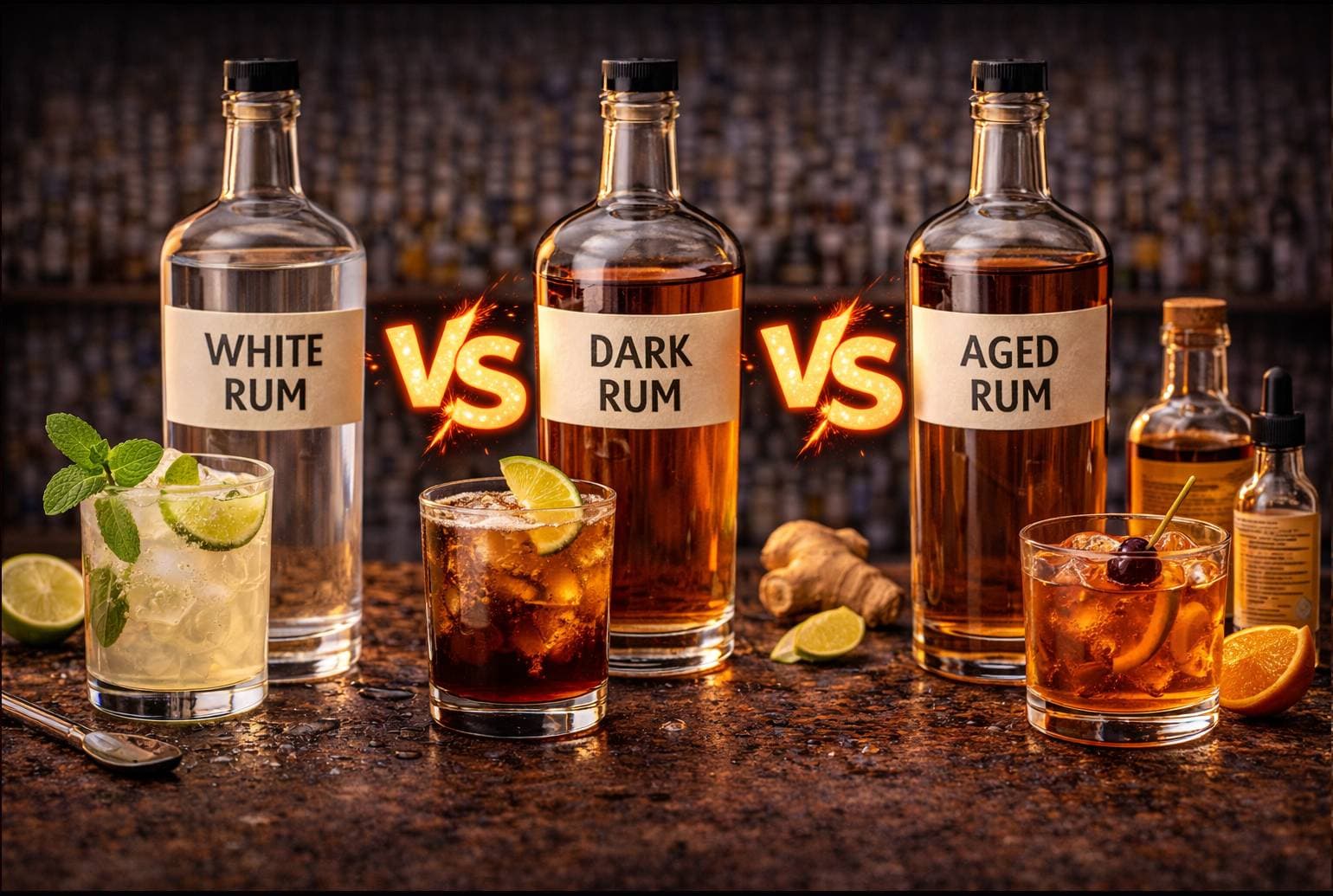
El ron proviene de la caña de azúcar, pero el ron blanco, oscuro y añejo tienen sabores distintos y diferentes usos en cócteles. Elegir el incorrecto cambia cómo sabe una bebida—y si se congela adecuadamente en una máquina de lotes.
Las Tres Categorías
Ron Blanco/Plateado se filtra para remover el color o se añeja por muy poco tiempo (típicamente menos de 1 año) y luego se filtra con carbón vegetal hasta quedar transparente. La filtración remueve los taninos del barril y cualquier cosa que le dé color al destilado. Lo que obtienes es limpio, ligero y dulce — lo más cercano a un destilado neutro de grano que encontrarás en el ron. El ron blanco sabe a caña de azúcar con un ligero ardor alcohólico. No hay roble, no hay carácter profundo de melaza, solo lo esencial. La mayoría de los rones blancos se embotellan a 40% ABV.
Ron Oscuro/Dorado se añeja el tiempo suficiente (usualmente 3–5 años) para adquirir color del barril, luego se filtra o se deja sin filtrar. El añejamiento más prolongado crea sabor más rico — melaza, caramelo, roble, y a veces un toque de vainilla. El color varía desde miel dorada hasta caoba profundo dependiendo de cuánto tiempo fue añejado y qué barril se usó. Algunos rones oscuros también tienen colorante de caramelo añadido (no es negativo — es parte del proceso). El ron oscuro tiene cuerpo y carácter; puedes saborear el destilado, no solo la dulzura. La mayoría de los rones oscuros se embotellan a 40% ABV.
Ron Añejo/Premium se añeja por 7+ años (a veces 15, 20, o más) en roble, y la edad usualmente se declara en la etiqueta. El ron añejo está hecho para degustarse — es tan complejo como un bourbon fino o Cognac. El añejamiento crea riqueza, suavidad, y desarrollo sutil de sabor que hace el destilado interesante por sí solo. Degustar un ron añejo de 12 años solo o con un solo cubo de hielo es el atractivo. La mayoría de los rones añejos se embotellan a 40% ABV, aunque algunas botellas premium van a 45–50% ABV.
Ron Oscuro Natural vs. Artificialmente Coloreado
Esta distinción importa más de lo que muchas personas se dan cuenta.
El ron oscuro añejado naturalmente obtiene su color de años en barril. Mientras más oscuro el ron, mayor el contacto con barril, y más rico el sabor. Estos rones fueron añejados, luego embotellados. El color es prueba de la inversión de tiempo.
El ron oscuro artificialmente coloreado es ron blanco con colorante de caramelo añadido antes del embotellado. Puede haber sido añejado en barril (o no), pero la oscuridad no es resultado de ese añejamiento — es un producto visual. El sabor aún puede ser complejo, pero el color es cosmético.
Para cócteles, esta diferencia importa menos que para degustar. Un Dark & Stormy hecho con ron oscuro añejado naturalmente y uno hecho con ron blanco artificialmente coloreado sabrán diferente, pero ambas versiones existen y se beben. La versión añejada naturalmente será más rica y más interesante. La versión artificialmente coloreada será más ligera y más cercana al ron blanco en sabor.
Cuando compres ron oscuro, mira la etiqueta. Si dice "añejado por X años" y lista una declaración de edad, es añejado naturalmente. Si no hay declaración de edad y solo dice "ron oscuro," puede estar artificialmente coloreado. Ambos son productos legítimos — solo sabe qué estás comprando.
Qué Ron para Qué Cóctel
Daiquiri (ron, lima, jarabe simple): Ron blanco. El Daiquiri clásico es un estudio en equilibrio — el ron debe ser un telón de fondo limpio para la lima y azúcar. La neutralidad del ron blanco es la base. Un Daiquiri de ron oscuro es más rico y más sustancial (algunas personas lo prefieren), pero el clásico es blanco.
Mojito (ron, lima, menta, jarabe simple, agua con gas): Ron blanco. La misma razón — quieres que la menta, lima y azúcar brillen. El ron está ahí por fuerza, no por sabor. Un mojito machacado con ron oscuro sabría turbio.
Dark & Stormy (ron oscuro, cerveza de jengibre, lima): Ron oscuro, específicamente. Esta bebida requiere la riqueza y carácter de melaza del ron oscuro. La especia de la cerveza de jengibre necesita la profundidad del ron oscuro para equilibrarla. Técnicamente puedes hacerla con ron blanco, pero se convierte en una bebida diferente (y menos interesante). Mientras más oscuro el ron, mejor el Dark & Stormy.
Ron Old Fashioned (ron añejo, bitter, azúcar, cáscara de naranja): Ron añejo u oscuro. Esta es una bebida revuelta centrada en el destilado donde quieres saborear el carácter del ron. Un ron de calidad para degustar es ideal. La complejidad del ron añejo, las notas de melaza del ron oscuro — ambos funcionan hermosamente. El ron blanco sabría delgado y unidimensional.
Ti' Punch (rhum agricole añejo, lima, jarabe simple): Rhum agricole añejo (una categoría específica de ron hecho de jugo de caña, no melaza). Esta es una bebida tradicional de Martinica, y está hecha para mostrar el ron. Necesitas algo con carácter y complejidad. El ron añejo regular funciona, pero el carácter herbáceo y complejo del rhum agricole es tradicional.
Mai Tai (ron añejo, ron ligero, licor de naranja, lima, orgeat, bitter): Tradicionalmente es una mezcla — ron oscuro añejo y ron blanco. El ron blanco proporciona fuerza limpia; el ron oscuro proporciona carácter y cuerpo. No uses todo oscuro o todo blanco — la combinación es lo que lo hace funcionar.
Bebidas Tiki (varias, a menudo combinando 2–3 rones): Los cócteles Tiki a menudo combinan ron blanco para fuerza y ron oscuro/añejo para carácter. La proporción varía por receta, pero el principio es el mismo: blanco para la estructura, oscuro para el interés.
Cócteles de ron congelados/en lotes (Daiquiri Congelado, Colada Congelada): El ron blanco usualmente es la mejor opción. Es limpio, no se enturbia al congelarse, y no compite con sabores de frutas. El ron oscuro en un lote congelado puede adquirir notas de sabor extrañas cuando se enfría mucho. Dicho esto, los Daiquiris Congelados de ron oscuro existen y se beben — solo ten en cuenta que el perfil de sabor será notablemente diferente (más rico, más centrado en melaza, menos refrescante).
Una Nota sobre el Ron Overproof
El ron overproof se embotella a 75–151% ABV (aproximadamente 75–75.5% ABV). No está hecho para degustarse solo — está hecho como flotador encima de bebidas tiki, potenciador de sabor para ponche, o elemento técnico en shots en capas. Una pequeña cantidad de ron de 151 grados flotando encima de un Mai Tai añade intensidad sin requerir que toda la bebida sea peligrosamente fuerte.
Para la mayoría de la coctelería casera, no necesitas overproof. El ron añejo o oscuro estándar a 40% ABV está bien. Pero si estás explorando Tiki o cócteles de ron de alta gama, overproof es una técnica que vale la pena entender.
Qué Comprar
Si compras una botella: Ron blanco. Es el más versátil y funciona en la mayoría de cócteles. Un ron blanco de rango medio en los $20–30 (como Bacardi, Flor de Caña, o Havana Club) cubre todo desde Daiquiris hasta Mojitos hasta Tiki. Es accesible y no exige ser la estrella.
Si compras dos botellas: Añade un ron oscuro. Mantén el blanco para Daiquiris y Mojitos. Añade ron oscuro para Dark & Stormys y para mezclar en bebidas Tiki. Una botella en el rango de $30–45 (como Gosling's Black Seal, Mount Gay, o Appleton) te da carácter serio de ron sin el precio premium del ron añejo.
Si compras tres botellas: Añade un ron añejo para degustar. Un ron añejo de 7–12 años en el rango de $40–70 (como Diplomatico, Ron Zacapa, o Plantation XO) te da calidad premium para degustar y funciona hermosamente en cócteles centrados en el destilado como el Ron Old Fashioned.
La cuestión del grado: El ron estándar es 40% ABV. Algunos rones añejos premium van a 45–50% ABV. El ron de mayor graduación mantiene mejor su sabor en cócteles, especialmente importante para bebidas en lotes. Para cálculos de lotes, recuerda que el ron a 40% ABV contribuye significativamente al contenido total de alcohol del lote — ajusta tu ABV final del lote en consecuencia. Ve nuestra guía sobre matemáticas de cócteles en lotes para los cálculos.
La Regla Rápida
Ron blanco para cócteles frescos, centrados en cítricos, ligeros — Daiquiris, Mojitos, cualquier cosa donde quieras dulzura de caña de azúcar sin carácter profundo de barril.
Ron oscuro para bebidas que necesitan riqueza y cuerpo — Dark & Stormys, bebidas Tiki, ponches de ron.
Ron añejo para degustar o cócteles centrados en el destilado donde quieres que el ron sea la estrella.
Cuando dudes sobre una receta, comienza con blanco. Es para lo que la mayoría de cócteles clásicos de ron fueron diseñados, y la dulzura limpia es lo que hace el ron accesible.
Navega nuestras recetas de cócteles de ron, revisa las recetas Tiki para bebidas que muestran ron añejo y oscuro, y usa el Emparejador de Ingredientes para encontrar bebidas basadas en el ron que tienes en casa.