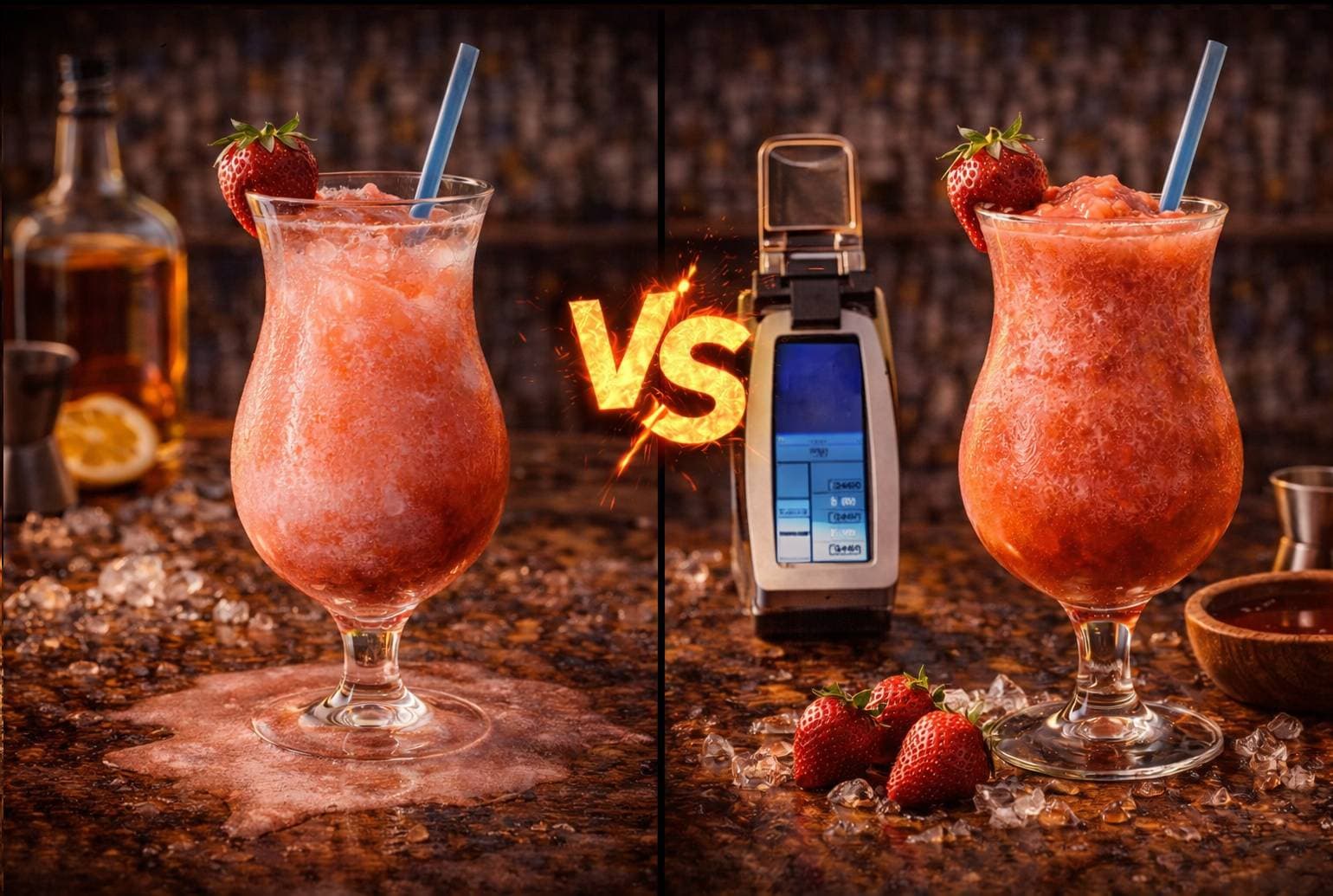
Vous avez chargé votre machine à boissons glacées, attendu qu'elle termine son cycle, et au lieu d'une margarita glacée épaisse et servable à la cuillère, vous avez obtenu une flaque graniteuse qui ne tient pas sa forme. Ou pire — un liquide boueux que la machine brasse sans fin sans jamais geler.
Le problème est presque toujours le Brix.
Le chiffre unique qui contrôle tout
Le Brix (°Bx) est une mesure de la teneur en sucre dissous dans un liquide. Pour les machines à boissons glacées, c'est le chiffre qui détermine si votre lot gèle en un granité lisse et stable ou échoue complètement. La plage idéale pour la plupart des machines à boissons glacées — qu'il s'agisse d'unités commerciales comme Spaceman et Elmeco, ou de machines grand public comme la Ninja SLUSHi — est 13–18 Brix.
Si vous ne mesurez pas le Brix avant de verser, vous devinez. Et deviner, c'est pourquoi vos boissons continuent de fondre.
Pour une explication complète de ce qu'est le Brix et comment il fonctionne, lisez notre guide : Qu'est-ce que le Brix et comment le vérifier avec un réfractomètre.
Pourquoi trop peu de sucre signifie un bloc solide
Lorsque votre Brix est inférieur à 13, la teneur en sucre n'est pas assez élevée pour abaisser suffisamment le point de congélation. Le compresseur de la machine refroidit le mélange au-delà du point où il devrait être granité, et tout le lot gèle dur. Dans une machine commerciale, une congélation solide peut bloquer la vis sans fin et surcharger le moteur. Dans une machine grand public, cela peut fissurer les composants internes.
Si vous avez déjà ouvert votre machine pour trouver un bloc de glace dur comme la pierre au lieu d'une boisson glacée, votre Brix était trop bas.
Pourquoi trop de sucre signifie que ça ne gèle jamais
Lorsque votre Brix est supérieur à 18, il y a tellement de sucre dissous que le point de congélation chute en dessous de ce que la machine peut atteindre. Le compresseur fonctionne, la vis sans fin tourne, mais le mélange n'épaissit jamais. Vous vous retrouvez avec un liquide froid qui circule sans fin.
C'est le problème de « continue de fondre » que la plupart des gens rencontrent. En réalité, ça ne fond pas — ça n'a jamais gelé au départ. C'est la teneur en sucre qui l'empêche.
Le troisième coupable : l'alcool
Le sucre n'est pas la seule chose qui abaisse le point de congélation — l'alcool le fait aussi, et il est sournois.
Même si votre Brix se lit parfaitement dans la plage 13–18, un lot avec trop d'alcool peut empêcher la congélation. Le taux d'alcool cible pour un lot glacé est 5–10% du volume final mélangé. Une margarita standard avec 60 ml de tequila dans un total de 240 ml versés fait environ 10% d'alcool — juste à la limite supérieure.
Les cocktails à forte teneur en spiritueux ne fonctionnent tout simplement pas dans les machines glacées, ou peuvent prendre plus de temps à geler. Un Negroni à 25% d'alcool ne gèlera pas quel que soit le contenu en sucre. Un Long Island Iced Tea avec cinq spiritueux non plus. Les recettes qui fonctionnent le mieux sont celles construites autour de jus, de mélangeurs et de quantités modérées de spiritueux — c'est exactement comment nos recettes par lot sont conçues.
Comment diagnostiquer votre lot
Voici un guide de dépannage rapide :
Le lot gèle dur / trop glacé : Votre Brix est trop bas (inférieur à 13). La solution est d'ajouter du sirop simple. Incorporez 30–60 ml de sirop simple 1:1 par 4 litres à la fois, mélangez soigneusement, et retestez avec un réfractomètre. Le sirop simple a un Brix d'environ 50, donc un peu suffit.
Le lot ne gèle pas / reste liquide : Soit votre Brix est trop élevé (supérieur à 18) soit votre taux d'alcool est trop élevé (supérieur à 10%), ou les deux. Si le Brix est le problème, ajoutez de l'eau par petits incréments — 30–60 ml par 4 litres — et retestez. Si le taux d'alcool est le problème, vous devez diluer avec un mélangeur non-alcoolisé (jus, eau, ou soda ajouté au moment de servir).
Le lot gèle mais fond rapidement une fois servi : Cela signifie généralement que votre Brix est dans la partie basse de la plage (13–14). La boisson gèle dans la machine mais n'a pas assez de sucre pour maintenir sa texture une fois dans un verre à température ambiante. Visez la partie haute de la plage — 16–18 Brix produit une texture glacée plus riche et plus stable.
Le lot est granité mais granuleux / glacé : Votre Brix est dans la plage 10–12 — assez proche pour geler, mais pas assez de sucre pour une texture lisse. Les cristaux de glace sont trop gros parce qu'il n'y a pas assez de solides dissous pour interrompre la formation des cristaux. Ajoutez du sirop simple pour l'amener dans la plage 13–18.
La solution est toujours la même : mesurer d'abord
Chacun de ces problèmes peut être évité avec une seule étape : vérifiez votre Brix avec un réfractomètre avant de verser le lot dans la machine.
Un réfractomètre Brix optique de base est peu coûteux et prend 30 secondes à utiliser. Placez quelques gouttes de votre lot mélangé sur le prisme, lisez le chiffre, et ajustez si nécessaire. C'est tout.
Voici l'aide-mémoire d'ajustement :
| Votre lecture | Statut | Action |
|---|---|---|
| En dessous de 10 | Beaucoup trop bas | Ajouter du sirop simple (1:1), 90–120 ml par 4 litres, retester |
| 10–12 | Trop bas | Ajouter du sirop simple (1:1), 30–60 ml par 4 litres, retester |
| 13–15 | Bon | Prêt à verser — la texture sera ferme et légèrement glacée |
| 16–18 | Idéal | Prêt à verser — texture lisse, crémeuse, stable |
| 19–22 | Trop élevé | Ajouter de l'eau, 30–60 ml par 4 litres, retester |
| Au-dessus de 22 | Beaucoup trop élevé | Ajouter de l'eau, 90–120 ml par 4 litres, retester |
Retestez toujours après chaque ajustement. De petits ajouts modifient le Brix plus que vous ne l'attendriez.
Recettes courantes qui causent des problèmes
Certains cocktails populaires sont naturellement difficiles à geler à cause de leurs ratios d'ingrédients :
Trop peu de sucre (gèle dur ou glacé) : Recettes riches en agrumes et spiritueux avec un édulcorant minimal. Un gin tonic de base adapté pour une machine gèlera dur — l'eau tonique ne fait qu'environ 8 Brix, et le gin n'apporte aucun sucre. Vous devriez ajouter du sirop simple significatif pour l'amener dans la plage.
Trop d'alcool (ne gèle pas) : Tout ce qui est riche en spiritueux. Manhattan, Martini, Old Fashioned — ces cocktails font 25–35% d'alcool en version individuelle et ne descendent pas assez même avec la dilution du lot. Tenez-vous aux boissons construites autour de jus et de mélangeurs.
Trompeusement difficile : Les Piña Colada semblent parfaites (la crème de coco est sucrée, le jus d'ananas est sucré), mais la crème de coco ne fait qu'environ 20 Brix et sa richesse vient largement des graisses, pas du sucre. Vous avez souvent besoin de plus de sirop simple que vous ne l'attendriez. Testez toujours.
Nos recettes par lot sont spécifiquement formulées avec le Brix à l'esprit — les ratios sont ajustés pour une congélation appropriée, pas seulement agrandis de la version individuelle. C'est exactement pourquoi les recettes par lot doivent être développées séparément plutôt que simplement multipliées.
Qu'en est-il des mélanges du commerce ?
Les mélanges de cocktails pré-faits (comme le mélange margarita du commerce) sont généralement formulés pour tomber dans la bonne plage Brix pour les machines glacées, puisque le fabricant a déjà équilibré la teneur en sucre. Si vous utilisez un mélange commercial, vous pouvez généralement le verser directement.
Les problèmes commencent quand vous ajoutez des spiritueux au mélange. L'alcool fait chuter le point de congélation effectif, et si vous avez la main lourde avec la tequila, le lot ne gèlera pas correctement. Suivez le ratio sur la bouteille, et en cas de doute, vérifiez avec un réfractomètre.
Arrêtez de deviner, commencez à mesurer
La différence entre un cocktail glacé qui garde sa forme et un qui fond en flaque est généralement de 3–5 points Brix. C'est une marge que vous ne pouvez pas estimer à l'œil nu et que vous ne pouvez pas atteindre au goût — mais c'est une marge qu'un réfractomètre lit instantanément.
Si vos boissons glacées continuent de fondre, la solution n'est pas une meilleure machine ou une recette différente. La solution est un réfractomètre à 20€ et 30 secondes de mesure.
Consultez nos recommandations de réfractomètre sur la page Outils de Bar, ou parcourez nos recettes de cocktails par lot pour des recettes testées de 4 litres avec des estimations Brix intégrées.
MixologyRecipe.com fournit des valeurs Brix estimées et des estimations de taux d'alcool à des fins éducatives. Vérifiez toujours avec un réfractomètre correctement calibré avant d'ajouter tout mélange à une machine à boissons glacées. Voir notre clause de non-responsabilité complète pour plus de détails.